Showing posts with label 1930s fiction. Show all posts

Saturday, January 7, 2017

Ernest Hemingway's FOR WHOM THE BELL TOLLS

I'm fifty years old.  I'm surprised that I never read Hemingway's great novel about the futility of war before now.  Hemingway's big three are The Sun Also Rises, A Farewell To Arms and For Whom the Bell Tolls.  I was assigned to read A Farewell to Arms my senior year in high school.  I am sure that I will appreciate more than I did then when I read it again.


For Whom the Bell Tolls is Hemingway's novel about the Spanish Civil War.  The Spanish Civil War was the cause celebre of the 1930s.  When a coalition of left wing parties won a majority of seats in the Spanish parliament, a group of army officers, eventually led by General Francisco Franco, launched a rebellion.


Franco and the "Nationalists" were aided by Hitler and Mussolini who sent troops and equipment.
The "Loyalists" or "Republicans" were aided by Stalin and the Soviet Union.  If you considered yourself an intellectual in the 1930s, it was the in thing to be a Communist.  Having romantic notions about the struggle of workers and peasants fighting facists, artists and intellectuals flocked to fight for Republican Spain.


The reality was that neither side in the Spanish Civil War had a real claim to moral superiority.  Both sides were guilty of horrible atrocities.  When either side would take a town, the first thing that usually happened would be that everyone identified as being a member of the other side would be marched to the nearest wall and shot, or as happens in the novel, thrown off of a cliff.


In 1937 Hemingway went to Spain to cover the war for the North American Newspaper Alliance. Between battles and drinks, he had time to carry on an affair with fellow news correspondent Martha Gelhorn who became the third Mrs. Ernest Hemingway.  Soon after arriving in Spain, Hemingway announced that he was writing a novel about the war.  By the time For Whom the Bell Tolls was published in 1940, the Nationalists had crushed the Spanish Republic.  The Spanish Civil War had only been a dress rehearsal for a much more horrible conflict.


The hero of For Whom the Bell Tolls is Robert Jordan.  Robert Jordan is the stereo typical Hemingway hero.  Jordan is a professor of Spanish at the University of Montana who has taken a leave of absence to volunteer to fight in Spain.  He worries that he won't be able to get his job back after the war because he's been identified as "a Red."  Like his creator, Jordan says that he's not a Communist he's just in favor of liberty.  He has put himself under Communist command and submitted to Communist discipline because the Communists are the only ones who can organize the army and win the war.  At the start of the war, the Republican Army was composed of militias of various factions, including Anarchists, various kinds of Socialists, and Communists.   The Communists tended to be the best organized.

Ernest Hemingway with Ingrid Bergman who starred as Maria with Gary Cooper as Robert Jordan  in the movie version of For Whom the Bell Tolls

Jordan is a demolition expert.  He has been assigned by a Soviet General, Golz, to destroy a bridge in the mountains to keep the Nationalists from moving equipment across while the Republican forces launch a surprise attack.  Jordan makes contact with the Republican Partisans who are fighting a guerilla war behind the Nationalist lines.  The partisans are led by the ruthless Pablo and his mistress Pilar.


Even in peacetime, Pablo would probably have been a bandito.  Prior to the opening of the novel, Pablo's band has destroyed and sacked a Nationalist train.  They rescued Maria, a nineteen year old girl who was a prisoner of the Nationalists.  Maria was the daughter of the Republican mayor of a town.  Her father and mother were both shot.   The fascists shaved Maria's head and then raped her. This all happened not long before the opening of the novel.  Pablo believes, rightly, that the operation to destroy the bridge is a suicide mission.  Pablo would much rather loot another train.


Pablo's mistress, Pilar, is one of Hemingway's great characters.  The former mistress of a matador, Pilar is introduced in the novel as "an old woman."  We later find out that Pilar is forty eight!  Pilar relates how Pablo massacred the Nationalist Civil Guard in his village and then threw the town officials and land owners over the side of a cliff.  Hemingway based this on a real incident which occurred in the town of Ronda in Andalucia.


When I say that Robert Jordan is the typical Hemingway hero, he's an intellectual who's also a real man.  He drinks hard, is pretty much fearless in the face of almost certain death, and women cannot resist him.  The novel takes place over four days time.  Even though she is traumatized from being brutally raped, only a few hours after meeting Robert Jordan, Maria is getting naked and crawling in his bed roll.  What a guy!


Hemingway also highlights the incompetence and lack of organization which plagued the Republican forces.  Seeing the Nationalists moving a lot of equipment across the bridge, Jordan realizes that the Nationalists have been tipped off about the Loyalist surprise attack.  Jordan sends one of the partisans, Andres, back to advise General Golz that the attack will fail.  It is in the scenes where Andres is trying to deliver the message to the Soviet General that we see all of the stupidity and disorganization of the Loyalist forces which will ultimately doom their cause to failure.

Anarchist propaganda poster from the Spanish Civil War.
F.A.I. stands for "Federacion Anarquista Iberica" or Iberian Anarchist Federation

 First the anarchists on the front lines have to debate whether they are going to let Andres pass or just shoot him on the spot.   Next, an insane Communist Party Commisar arrests Andres and a loyal Republican officer on suspicion of being traitors.  Finally, Jordan's message gets to the General's aide but it is too late to stop the attack.

"They shall not pass!"  Republican propaganda poster.

As the 1965 Cliffs Notes summarize it: "So, here is the crowing irony of the book.  Jordan must blow up a bridge, the destruction of which will be absolutely of no value.  He must carry out his ineffectual assignment because of the ignorance, stupidity, indifference, and self-importance of people who should most logically have done all they could to help his courier get to his destination in time."


I have read on the internet that a lot of people do not like the style which Hemingway used to write For Whom the Bell Tolls.  In order to convey the flavor of the language spoken by the Spanish peasants Hemingway has used "thee" and "thou."  He also sometimes puts the word order the way it would be in Spanish which sounds unnatural in English.  This is the same device he will use for the old Cuban fisherman in The Old Man and the Sea.   Another device which is off-putting to modern readers is the device of not saying profanity.  Over and over again we hear the partisans say something like "I obscenity in your mother's milk!"   To modern readers this seems really silly.  We have to realize that had Hemingway actually come out and said "I piss in your mother's milk," his book would never have been published by a reputable publisher and would have been subject to censorship.


A fascinating sub theme that runs through the novel is the loss of God.  The Catholic Church in Spain was identified by the left as allied with the monarchists and large landowners.  The Anarchists and Communists believed that throughout Spanish history the Church had been used as a tool to oppress and control the workers and peasants.  Especially early in the conflict, many atrocities were carried out against priests, monks and nuns.  Many churches were looted and desecrated.  Even though the old religion is gone, the Spanish peasants fighting for the Republic still cling to the mystical heritage of Catholicism.  Pilar relates to Robert Jordan how disappointed Pablo was that the priest in his village did not die bravely.  Even though Pablo rejected the Church and all its teachings, he expected more from a Spanish Priest.

Republican propaganda poster seeking foreign help.

There is a reason that Ernest Hemingway has the reputation of being one of the greatest writers of the 20th century.  Hemingway's reputation has suffered a great deal in the last few decades because he is seen as a super macho sexist with outdated patriarchal attitudes.  Regardless of all that, I think that Hemingway's work lives up to his reputation.  I enjoyed reading this great classic and recommend it highly.


Saturday, August 27, 2011

James M. Cain's DOUBLE INDEMNITY


“I stared into the darkness some more that night. I had killed a man, for money and a woman. I didn’t have the money and I didn’t have the woman. The woman was a killer, out-and-out, and she had made a fool of me. She had used me for a cat’s paw so she could have another man, and she had enough on me to hang me higher than a kite. . . . I got to laughing, a hysterical cackle, there in the dark.” So James M. Cain’s character Walter Huff explains his dilemma in the crime noir classic Double Indemnity.


Following up on his run away commercial success with The Postman Always Rings Twice, Double Indemnity was written as a serial for Liberty Magazine. According to The Encyclopedia of Pulp Fiction Writers, Double Indemnity “. . . was meant to be a quickie job that Cain vowed would never be reprinted as a book. While researching Postman, Cain had talked to some insurance investigators, and with another real-life crime for inspiration he wrote a story about a woman conspiring with an insurance salesman to kill her husband and collect on his policy.” Double Indemnity originally appeared as a serial in Liberty Magazine in 1936, and, despite Cain’s initial reservations, was published in hardcover with two other of Cain’s novellas in 1943.


Although Cain has been accused of merely writing a re-hash of Postman, I found Double Indemnity to be a much darker tale. The main characters of Double Indemnity, Walter Huff and Phyllis Nordlinger, are much more evil than Frank Chambers and Cora Papadakis, the murdering adulterers of The Postman Always Rings Twice. Whereas Postman’s Frank Chambers just kind of falls into murder, Walter Huff knows that Phyllis wants to kill her husband and is more than willing to cooperate for a cut of a $50,000 accidental death policy. Frank and Cora murder solely for love/lust. Walter and Phyllis murder for money. Whereas Frank Chambers is a drifter and a loser and Cora Papadakis is a bored house wife, Walter Huff is a successful insurance salesman with a desire to cheat the insurance company and Phyllis Nirdlinger turns out to be a serial killer.


Walter Huff met Phyllis Nirdlinger when he went to the Nirdlinger home to see oil company executive H.D. Nirdlinger about renewing his automobile insurance. Huff makes his sales pitch to Mrs. Nirdlinger who has come downstairs in her pajamas:


“Under those blue pajamas was a shape to set a man nuts . . .

But all of sudden she looked at me, and I felt a chill creep straight up my back and into the roots of my hair. “Do you handle accident insurance?”

Maybe that don’t mean to you what it meant to me. Well, in the first place, accident insurance is sold, not bought. You get calls for other kinds, for fire, for burglary, even for life, but never for accident. The stuff moves when agents move it, and it sounds funny to be asked about it. In the second place, when there’s dirty work going on, accident is the first thing they think of. . . . there’s many a man walking around today that’s worth more to his loved ones dead than alive, only he don’t know it yet.”


Walter and Phyllis conspire to have Phyllis’ husband take out an accidental death policy and murder him for the insurance money. Nirdlinger believes that he is signing a renewal for his automobile insurance when he is really signing an application for accidental death insurance. The $25,000 policy has a double indemnity clause for dying in a railroad accident, so Walter devises a plan to make it look like Mr. Nordlinger fell off of a train and broke his neck. When Nirdlinger has a real accident and breaks his leg, he can no longer drive to a class reunion he planned to attend and Phyllis convinces him to take the train. Walter kills Mr. Nirdlinger by breaking his neck and then, posing as Nirdlinger and wearing a cast on his foot and hobbling on crutches, Walter boards the train and jumps off the observation platform. Phyllis drives the body to the spot where Walter jumped off the train where they deposit the victim’s body. Phyllis and Walter have iron clad alibis and it appears that Nirdlinger genuinely broke his neck falling off the train.


However, Barton Keyes, the claims investigator for the insurance company (brilliantly played by Edward G. Robinson in the 1944 movie version), is convinced that Nirdlinger has been murdered. Keyes, however, is also convinced that Walter Huff is a dedicated insurance man and confides in him. Huff, of course, uses the information to avoid detection.


Walter is redeemed when he falls in love with Nirdlinger’s step daughter, Lola. Phyllis was a nurse. Lola’s mother was related to a child which Phyllis was caring for in the hospital. The child was the heir to a large sum of money and property. This child and two others died in mysterious circumstances in the hospital under the care of Phyllis. Lola’s mother then inherited the fortune. Lola tells Walter that she suspects that Phyllis murdered her mother. Shortly after her mother’s death, Phyllis married Lola’s father.


The plot is rather complex, with Lola’s boyfriend being the son of a doctor who was ruined by Phyllis who pretends to dump Lola and seduce Phyllis seeking to get evidence against her. Walter decides that he must murder Phyllis in order to protect himself but is double crossed when Phyllis shoots him in the chest and Lola and her boyfriend are wrongfully accused of the crime.


Because of his love for Lola, Walter decides to confess to his friend Keyes, the insurance investigator. There is then an elaborate plot by the insurance company executives and lawyers to minimize bad publicity by avoiding a criminal trial. Walter and Phyllis flee the country on board a ship paid for by the insurance company.


The ending of Double Indemnity is chilling as Walter and Phyllis join each other in a suicide pact:

“There’s nothing ahead of us, is there Walter?

No. Nothing. . . .

“. . . Walter, the time has come.”

“What do you mean, Phyllis?”

“For me to meet my bridegroom. The only one I ever loved. One night I’ll drop off the stern of the ship. Then, little by little I’ll feel his icy fingers creeping into my heart.”

“. . . I’ll give you away.”

“What?”

“I mean: I’ll go with you.”

“It’s all that’s left, isn’t it?”

. . . I’m writing this in the stateroom. It’s about half past nine. She’s in her stateroom getting ready. She’s made her face chalk white, with black circles under her eyes and red on her lips and cheeks. . . . She looks like what came aboard the ship to shoot dice for souls in the Rime of the Ancient Mariner.”


Barbara Stanwyck as Phyllis and Fred MacMurray as Walter

The 1944 movie version of Double Indemnity, starring Fred MacMurray as Walter and Barbara Stanwyck as Phyllis, is considered to be a classic of the film noir genre. It was directed by legendary director Billy Wilder who co-wrote the screenplay along with famed “hard-boiled” detective writer Raymond Chandler. As a personal note, the first time I saw Double Indemnity, I was home sick and watching it on AMC. There was a real estate closing involving some investment property that was scheduled for that day. My wife showed up with a secretary to get me to sign a power of attorney to allow her to act for me at the closing. After just watching Fred MacMurray obtain the signature of his victim on an accidental death policy he thought was his car insurance renewal, I was just a little reluctant to sign.


The novella Double Indemnity is a classic of the Crime Noir genre and should continue to be read and enjoyed well into the future.


WHAT IS CRIME NOIR?

From the Foward “James M. Cain - Father of Noir” in James M. Cain: Hard-Boiled Mythmaker by David Madden (Scarecrow Press, 2011):

“So now we come to the term "noir". Originally this was a word used by French film critics to discuss American crime films whose subject matter was dark and whose lighting effects, courtesy of German expressionism, was darker. Many of these were cheap B movies, where a master of cinematography like John Alton could hide the lack of proper art design and set direction by “painting with light.” Among the most influential of the bigger-budget films noir was Wilder’s "Double Indemnity".

French film critics using the term film noir were referencing the "Serie noire", a line of crime novels published by Gallimard - black covered paperbacks reprinting Cain and other American writers, many of whom were his imitators. Gallimard began the "Serie noire" in the forties, and it continues to this day. . . .

In the sixties, American film critics . . . began using the term film noir, and in the subsequent decades it has been so basterdized as to be almost meaningless. Most critics agree that noir films date from around 1941 to 1955, have dark subject matter and atmospheric lighting, and are in black-and-white. Subsequent crime films of a noirish nature - like the definitive Cain patische, "Body Heat" - are usually called neo-noir.

In recent years, in American publishing the term "hard-boiled" has become tarnished due to its old-fashioned ring (it’s a World War I term, after all, pertaining to tough top sergeants), and “tough guy” is even more unpopular and antiquated. . . .

Just as American film critics co-opted the term film noir from the French, American book critics (and editors and publishers and even authors) appropriated it to describe that which mustn’t be termed "hard boiled". . . .

Vague as it is, noir as a definition or perhaps category has pushed out “hard-boiled,” a term Cain hated. So it’s time to remind everyone that James M. Cain, in "The Postman Always Rings Twice" and his next several novels, defined and perfected the dark crime novel, which gave birth to the films named after the French book series of which Cain was a major part and prime influence.

Without Cain, there is - no matter how you define it - no noir.

He is its daddy.

And he was very, very strict.”


Thursday, August 25, 2011

THE POSTMAN ALWAYS RINGS TWICE


“They threw me off the haytruck about noon.” So begins one of the most famous crime noir novels of all time, The Postman Always Rings Twice.

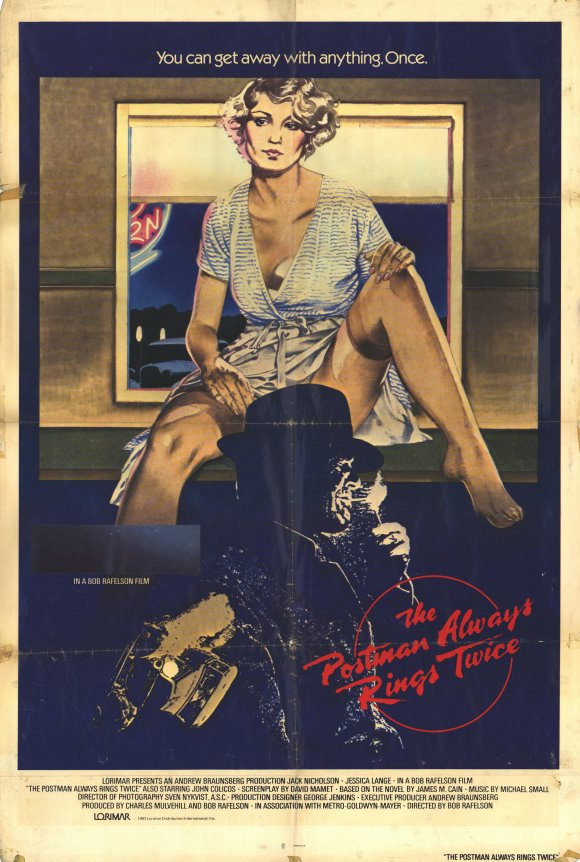
Neither of the two movies, neither the 1946 Lana Turner - John Garfield version nor the 1981 Jessica Lange - Jack Nicholson version, really do this book justice, although the Lange - Nicholson movie follows the novel much more closely. The “hard boiled” style has now been parodied so much that it is hard to realize how new and fresh this writing was in 1934 when Postman was first published.


The plot of Postman is well known. Frank Chambers is a no good drifter who lands at the Twin Oaks Tavern which, as Frank describes it, “ . . . was nothing but a roadside sandwich joint, like a million others in California. There was a lunchroom part, and over that the house part, where they lived, and off to one side a filling station, and out back a half dozen shacks that they called an auto court.”


The Twin Oaks Tavern is owned by a middle aged Greek immigrant named Nick Papadakis and his pretty young wife Cora. Cora won a beauty contest in Iowa and came to Hollywood trying to break into the movie business. Although Cora’s looks may have been enough to make her a silent movie star, the recent advent of talking pictures has doomed any chance Cora has of being a movie star.

“They gave me a test. It was all right in the face. But they talk, now. The pictures, I mean. And when I began to talk, up there on the screen, they knew me for what I was, and so did I. A cheap Des Moines trollop that had as much chance in pictures as a monkey has. A monkey, anyway, can make you laugh. All I did was make you sick.”


After washing out in the movies, Cora is forced to wait tables in seedy dives. Cora has married “the Greek” for financial reasons. Although the Greek is a likeable man who works hard and treats Cora well, Cora does not love him and is not sexually excited by him. When the Greek offers Frank the drifter a job working in the gas station, Frank takes it with the idea of trying to seduce Cora. Being bored in her marriage, Cora is easily seduced. There is just a hint of Sado-Masochism in the first sexual encounter between Cora and Frank:


“I took her in my arms and mashed my mouth up against hers . . . “Bite me! Bite me!”

I bit her. I sunk my teeth into her lips so deep I could feel the blood spurt into my mouth. It was running down her neck when I carried her upstairs.”


This was very racy stuff in 1934. Lines like this and “She looked like the great-grandmother of every whore in the world,” caused this book to be considered scandalous in its time and caused it to be one of those books which was “banned in Boston.”


In any event, Cora and Frank conspire to murder the Greek. Actually it’s more Cora than Frank. Even though Frank is a loser and an ex-con, he is a likeable character. After staying with Frank’s first person narration for the whole novel, the reader comes to feel that Frank is an old friend. Frank is reluctant to kill Nick when Cora first suggests it:

“. . . I’ve made one mistake. And I’ve got to be a hell cat, just once, to fix it. But I’m not really a hell cat, Frank.”

“They hang you for that.”

“Not if you do it right. You’re smart, Frank. I never fooled you for a minute. You’ll think of a way. Plenty of them have. Don’t worry. I’m not the first woman that had to turn hell cat to get out of a mess.”

“He never did anything to me. He’s all right.”

“The hell he’s all right. He stinks, I tell you. He’s greasy and he stinks. And do you think I’m going to let you wear a smock, with Service Auto Parks printed on the back, Thank-U Call Again, while he has four suits and a dozen silk shirts? Isn’t that business half mine? Don’t I cook? Don’t I cook good? Don’t you do your part?”

“You talk like it was all right.”

“Who’s going to know if it’s all right or not, but you and me?”

“You and me.”


Jack Nicholson and Jessica Lange as Frank Chambers and Cora Papadakis

Cora is really the ruthless one with the least moral scruples. Even though he becomes a cold blooded killer, Frank does seem to have a certain morality about him. Cora is eager to kill the Greek but Frank is a reluctant killer. “He never did anything to me. He’s all right.” But Frank’s lust for sexy Cora outweighs Frank’s scruples.

Jessica Lange as Cora and John Colicos as "the Greek"

This novel is so well known, I feel no need to go through the entire plot in detail. Having been a lawyer in criminal courts for over twenty years, I felt that the courtroom and legal scenes in The Postman Always Rings Twice are very realistic. I noticed that in the 1981 Jack Nicholson movie, the name of the conniving criminal defense lawyer, Katz, had been changed to something less Jewish sounding. I wonder if it was felt that Cain was making an anti-semitic swipe against “Jewish lawyers,” since Katz is interested only in making a big splash and winning his case and has no interest in justice whatsoever.


Since author James M. Cain was writing a morality tale, he couldn't allow the murderers to live happily ever after. Just when it looks like Frank and Cora are really going to settle down and have babies disaster strikes. After having gotten away with murdering the Greek, Frank is wrongfully convicted of murdering pregnant Cora after she dies in a tragic accident while Frank was trying to rush her to the hospital. The novel ends with Frank on death row about to be executed for the murder he didn’t commit.


According to The Encyclopedia of Pulp Fiction Writers “Dashiell Hammett, Raymond Chandler, and James M. Cain are the father, son, and holy ghost of American hard-boiled literature.” Prior to authoring Postman, Cain was a successful journalist and a not so successful playwright and screenwriter.

James M. Cain

Reportedly, the inspiration for Postman was the Ruth Snyder - Judd Grey case where an adulterous couple conspired and murdered the woman’s husband. There is a famous picture covertly snapped by a reporter of Ruth Snyder dying in New York’s electric chair.

The infamous photograph of the execution of Ruth Snyder

The title has always caused some confusion since there is no postman in the story. Cain had originally named the story “Bar-B-Que” but the publisher, Alfred A. Knopf, wanted another title. The “Postman” who “always rings twice,” is God or fate. Frank and Cora got away with murder the first time, but then the postman came back and delivered punishment.

Lana Turner and John Garfield as Cora Papadakis and Frank Chambers

Although Cain continued to write novels up until his death in 1977, he never recaptured the run away success of The Postman Always Rings Twice. His next novel, Double Indemnity (1943), is basically a re-hash of the same story, involving this time an insurance salesman and the wife of a client.


The Postman Always Rings Twice is short, only 35,000 words. Apparently, Knopf had to print it in larger than normal type to make it look like it was longer. As one article which I read on the internet said, “It will take you longer to watch either movie version than to read the book.” Even after all these years, The Postman Always Rings Twice is still able to work its magic on readers. It is still a powerful, gripping story and the sparse, muscular Hemingway-esque “hard-boiled” style can still grab you. The Postman Always Rings Twice well deserves its reputation as a classic.


Saturday, March 26, 2011

Graham Greene's England Made Me


As promised, I have now read Graham Greene’s 1935 novel England Made Me. England Made Me is the story of Anthony Farrant. Anthony is a ne’er-do-well and a rake who has been a failure at one job after another all over the world. Anthony has a very close relationship, which borders on incest, with his twin sister, Kate. Kate is the personal secretary and mistress to Erik Krogh, a wealthy Swedish businessman. Through Kate’s influence, Anthony obtains a job as Krogh’s bodyguard.


Krogh is ruthless and amoral in his pursuit of more wealth and power. A central theme of this book is internationalism. Krogh has no allegiance to any country. His only loyalty is to himself and his fortune. There is a good bit of talk in this novel about how nations and borders will be a thing of the past in the modern world with quick travel by airplane and instant communication by telephone and radio. In retrospect, the premise that nationalism is on the way out is kind of laughable for a novel published in 1935, two years after Hitler took power in Germany in 1933 and four years before the outbreak of World War II in Europe in 1939. However, it's no more laughable than reading things published in the 1990s after the Soviet Union fell that opined that we had entered a new era of world peace and prosperity.


Krogh is engaged in all kinds of shady business deals to sell worthless stock and defraud shareholders. Krogh also lies to a labor union leader to avoid a strike and then frames the man for wrongdoing and ruins his reputation before firing him. Krogh’s closest thing to a friend is Hall, who has known Krogh since they were both poor young men. Although Krogh has treated Hall badly through the years, Hall is fanatically loyal to Krogh and would do anything for him. Just as Anthony and Kate’s relationship borders on the incestuous, Hall’s infatuation with Krogh borders on the homoerotic.


By far the the most interesting character in the entire novel is Ferdinand Minty, an expatriot Englishman who is employed as a reporter by a Swedish newspaper. Minty is wonderfully eccentric. He lives in a seedy tenement and wears a wrinkled old coat and suit. He is a sadist who tortures a spider by watching it under a glass until it dies. He constantly refers to himself in the third person and is a diehard Anglo-Catholic who is constantly praying to obscure saints. Minty is an alumnus of Harrow, the English public school. When he sees Anthony wearing a Harrow school tie and begins to ask him questions, Minty almost immediately recognizes Anthony as a fraud. Minty’s assignment from his editor is to report on Erik Krogh, so Minty offers to bribe Anthony to leak information to him.


Since this is an obscure 76 year old novel, I think that I won’t be hurting much by spoiling the ending. Anthony is appalled by Krogh’s amoral business practices and decides to leak the information to Minty and then return to England where he plans to have a true relationship with his current mistress whom, up to now, he has used merely as a sex object. When Anthony leaks that Krogh is planning to marry Kate, Krogh realizes that Anthony is about to ruin his reputation and wants to prevent Anthony returning to England. Hall engineers a late night poker game to attempt to have Anthony run up large gambling debts and be unable to leave Sweden. After being foiled in this plan because Anthony already has tickets to sail to England, Hall murders Anthony whose death is made to look like an accident. The End.

If the above plot summary seems lame, let me assure you that this book is just as lame as it sounds. This is not one of Greene’s better novels. In fact, I daresay that if Graham Greene wasn’t Graham Greene, this novel would be long out of print and forgotten. However, England Made Me is still of interest because of the view of the world it presents. In 1935 the world was in the midst of the Depression and no one knew that the world stood on the edge of the abyss of the bloodiest war in human history. This novel is also of interest because it is one of Greene’s early efforts which shows the master honing his craft. Like It’s a Battlefield, the technical execution of England Made Me is very good and there is some excellent writing in it in places. As a whole, though, it just doesn’t really work. Once again, I think that Greene was trying too hard to write a “serious novel” and it just doesn’t deliver the goods.