Showing posts with label Modern Literature. Show all posts

Saturday, January 21, 2017

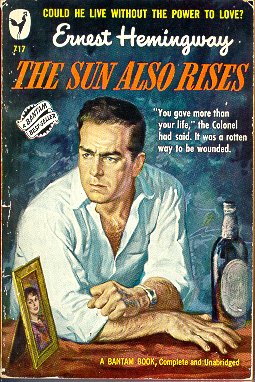
Ernest Hemingway's THE SUN ALSO RISES

When Hemingway's first novel, The Sun Also Rises, was published in 1926 quite a few people were shocked.


Hemingway's mother thought it was the most pornographic book she'd ever read.  Grace Hemingway wrote Ernest a letter and told him how embarrassed she was and surely he knew some words other than "damn" and "bitch."


Hemingway's fellow ex-patriot friends were also shocked.  The characters of A Sun Also Rises were thinly veiled caricatures of Hemingway and his friends.  The main character, Jake Barnes, was Hemingway, his love interest Lady Brett Ashley was Duff Twysden, Robert Cohn was Harold Loeb. They were shocked.  Duff Twysden was especially shocked to see herself portrayed by Hemingway as a nymphomaniac who sleeps with every man in sight and even seduces a nineteen year old matador.


Hemingway had originally considered naming the novel The Lost Generation.  The writer Gertrude Stein had commented to Hemingway that all of the young people who fought in World War I were "A Lost Generation."

Ernest Hemingway and friends.
To quote Sean Hemingway's introduction to the recent Hemingway Library Edition of A Sun Also Rises:  "Characters from The Sun Also Rises who were in the war - Jake Barnes, Brett Ashley, and Mike Campbell - are broken physically and mentally.  Brett loses her first true love to the war, and no number of liasons fills the void.  Mike Campbell is an alcoholic and Jake is physically wounded, though the specific nature of his wound is never described in the book.  In an interview with George Plimpton, Hemingway said that Jake Barnes was not emasculated; his testicles were intact and not damaged, so he was capable of all normal feelings of a man but incapable of consummating them.  It was a very particular type of wound of which Hemingway had learned while he was at the Italian front."


And there is the central plot of The Sun Also Rises.  Jake Barnes is a red blooded American male.  He likes to fish and go to boxing matches and bullfights.  He was a fighter pilot on the Italian front in the war.  But Jake Barnes received a horrible wound in the war.  Although we are never told the exact nature of his wound, Jake Barnes can no longer perform sexually.


Jake is extremely attracted to Lady Brett Ashley.  Brett, in return, is extremely attracted to Jake. Because of his war wound, Jake can never satisfy Brett sexually and neither of them is satisfied to live together without it.


Robert Cohn, the author of a third rate novel, is everything that Jake Barnes isn't.  Although he was a boxing champion at Princeton he never liked boxing and only participated in the sport because he thought he had to.  Cohn is dominated by the women in his life.  As Jake is physically emasculated, Cohen is spiritually emasculated.   Brett, who is engaged to marry the alcoholic Mike Campbell,  goes off the beach in Spain with Cohn for a week.  After Brett sleeps with him, Cohn follows Brett around like a whipped puppy dog and won't leave her alone.


An alternative name that Hemingway considered for the novel is Fiesta.  In fact, this is the name that the novel is still published under in the United Kingdom.  Although the novel opens in Paris, the central action occurs during the Feast of Saint Fermin in Pamplona, Spain.  The running of the bulls through the streets and the subsequent bull fights are meticulously described.


All of the men in Brett Ashely's life are somehow emasculated.  The young matador, Pedro Romero, is the picture of masculinity.  Romero is fearless and virile.  The thirty four year old Brett wants the nineteen year old Romero.


Jake's old friend, the owner of the hotel the group is staying at in Pamplona, asks Jake to help him keep young Pedro Romero from being corrupted by fame before he can rise to his full potential as a matador. Jake promises to do so.  When Brett asks Jake to fix her up with Romero, Jake can refuse her nothing.  When Robert Cohn accuses Jake of being Brett's pimp, one of the reasons Jake gets so mad is because he recognizes that the charge is true.  Jake also loses his reputation with the hotel owner and knows he will never be welcome again.

Ernest Hemingway in Paris in 1924

The 1968 edition of the Cliffs Notes summarizes the ending nicely:  "She sent Romero back to his world because they were happy and she was aware that their happiness would not last; he wanted her to let her hair grow and become a real woman, so, she granted herself a beautiful memory while she could.  


Besides, Romero was nineteen, Brett thirty-four.  In a short, short time her age and her past would be ridiculous were she to take up with Romero.  The young hero would be in the first years of his prime.  And Brett? She would be an unhappy, aging beauty trailing after the young Spanish god.  Brett returns to her world; here she can be irresponsible again; she will marry Mike Campbell and she can once more wonder about Jake and herself.  


Could they have been happy?  Jake says it's 'pretty' to think so, knowing full well that sex would only have eased them into a beginning of God-knows what.  Brett suggests that sex would have been terribly good between them and would have served them well but Jake does not accept this conjecture.  It's only a game, this speculating, and it is, in a sense, comforting, but it has nothing to do with reality.  Chasing after "as if's" is, in the words of Ecclesiastes (the source of Hemingway's title for this novel) all 'vanity and a chasing after the wind.'


Saturday, January 7, 2017

Ernest Hemingway's FOR WHOM THE BELL TOLLS

I'm fifty years old.  I'm surprised that I never read Hemingway's great novel about the futility of war before now.  Hemingway's big three are The Sun Also Rises, A Farewell To Arms and For Whom the Bell Tolls.  I was assigned to read A Farewell to Arms my senior year in high school.  I am sure that I will appreciate more than I did then when I read it again.


For Whom the Bell Tolls is Hemingway's novel about the Spanish Civil War.  The Spanish Civil War was the cause celebre of the 1930s.  When a coalition of left wing parties won a majority of seats in the Spanish parliament, a group of army officers, eventually led by General Francisco Franco, launched a rebellion.


Franco and the "Nationalists" were aided by Hitler and Mussolini who sent troops and equipment.
The "Loyalists" or "Republicans" were aided by Stalin and the Soviet Union.  If you considered yourself an intellectual in the 1930s, it was the in thing to be a Communist.  Having romantic notions about the struggle of workers and peasants fighting facists, artists and intellectuals flocked to fight for Republican Spain.


The reality was that neither side in the Spanish Civil War had a real claim to moral superiority.  Both sides were guilty of horrible atrocities.  When either side would take a town, the first thing that usually happened would be that everyone identified as being a member of the other side would be marched to the nearest wall and shot, or as happens in the novel, thrown off of a cliff.


In 1937 Hemingway went to Spain to cover the war for the North American Newspaper Alliance. Between battles and drinks, he had time to carry on an affair with fellow news correspondent Martha Gelhorn who became the third Mrs. Ernest Hemingway.  Soon after arriving in Spain, Hemingway announced that he was writing a novel about the war.  By the time For Whom the Bell Tolls was published in 1940, the Nationalists had crushed the Spanish Republic.  The Spanish Civil War had only been a dress rehearsal for a much more horrible conflict.


The hero of For Whom the Bell Tolls is Robert Jordan.  Robert Jordan is the stereo typical Hemingway hero.  Jordan is a professor of Spanish at the University of Montana who has taken a leave of absence to volunteer to fight in Spain.  He worries that he won't be able to get his job back after the war because he's been identified as "a Red."  Like his creator, Jordan says that he's not a Communist he's just in favor of liberty.  He has put himself under Communist command and submitted to Communist discipline because the Communists are the only ones who can organize the army and win the war.  At the start of the war, the Republican Army was composed of militias of various factions, including Anarchists, various kinds of Socialists, and Communists.   The Communists tended to be the best organized.

Ernest Hemingway with Ingrid Bergman who starred as Maria with Gary Cooper as Robert Jordan  in the movie version of For Whom the Bell Tolls

Jordan is a demolition expert.  He has been assigned by a Soviet General, Golz, to destroy a bridge in the mountains to keep the Nationalists from moving equipment across while the Republican forces launch a surprise attack.  Jordan makes contact with the Republican Partisans who are fighting a guerilla war behind the Nationalist lines.  The partisans are led by the ruthless Pablo and his mistress Pilar.


Even in peacetime, Pablo would probably have been a bandito.  Prior to the opening of the novel, Pablo's band has destroyed and sacked a Nationalist train.  They rescued Maria, a nineteen year old girl who was a prisoner of the Nationalists.  Maria was the daughter of the Republican mayor of a town.  Her father and mother were both shot.   The fascists shaved Maria's head and then raped her. This all happened not long before the opening of the novel.  Pablo believes, rightly, that the operation to destroy the bridge is a suicide mission.  Pablo would much rather loot another train.


Pablo's mistress, Pilar, is one of Hemingway's great characters.  The former mistress of a matador, Pilar is introduced in the novel as "an old woman."  We later find out that Pilar is forty eight!  Pilar relates how Pablo massacred the Nationalist Civil Guard in his village and then threw the town officials and land owners over the side of a cliff.  Hemingway based this on a real incident which occurred in the town of Ronda in Andalucia.


When I say that Robert Jordan is the typical Hemingway hero, he's an intellectual who's also a real man.  He drinks hard, is pretty much fearless in the face of almost certain death, and women cannot resist him.  The novel takes place over four days time.  Even though she is traumatized from being brutally raped, only a few hours after meeting Robert Jordan, Maria is getting naked and crawling in his bed roll.  What a guy!


Hemingway also highlights the incompetence and lack of organization which plagued the Republican forces.  Seeing the Nationalists moving a lot of equipment across the bridge, Jordan realizes that the Nationalists have been tipped off about the Loyalist surprise attack.  Jordan sends one of the partisans, Andres, back to advise General Golz that the attack will fail.  It is in the scenes where Andres is trying to deliver the message to the Soviet General that we see all of the stupidity and disorganization of the Loyalist forces which will ultimately doom their cause to failure.

Anarchist propaganda poster from the Spanish Civil War.
F.A.I. stands for "Federacion Anarquista Iberica" or Iberian Anarchist Federation

 First the anarchists on the front lines have to debate whether they are going to let Andres pass or just shoot him on the spot.   Next, an insane Communist Party Commisar arrests Andres and a loyal Republican officer on suspicion of being traitors.  Finally, Jordan's message gets to the General's aide but it is too late to stop the attack.

"They shall not pass!"  Republican propaganda poster.

As the 1965 Cliffs Notes summarize it: "So, here is the crowing irony of the book.  Jordan must blow up a bridge, the destruction of which will be absolutely of no value.  He must carry out his ineffectual assignment because of the ignorance, stupidity, indifference, and self-importance of people who should most logically have done all they could to help his courier get to his destination in time."


I have read on the internet that a lot of people do not like the style which Hemingway used to write For Whom the Bell Tolls.  In order to convey the flavor of the language spoken by the Spanish peasants Hemingway has used "thee" and "thou."  He also sometimes puts the word order the way it would be in Spanish which sounds unnatural in English.  This is the same device he will use for the old Cuban fisherman in The Old Man and the Sea.   Another device which is off-putting to modern readers is the device of not saying profanity.  Over and over again we hear the partisans say something like "I obscenity in your mother's milk!"   To modern readers this seems really silly.  We have to realize that had Hemingway actually come out and said "I piss in your mother's milk," his book would never have been published by a reputable publisher and would have been subject to censorship.


A fascinating sub theme that runs through the novel is the loss of God.  The Catholic Church in Spain was identified by the left as allied with the monarchists and large landowners.  The Anarchists and Communists believed that throughout Spanish history the Church had been used as a tool to oppress and control the workers and peasants.  Especially early in the conflict, many atrocities were carried out against priests, monks and nuns.  Many churches were looted and desecrated.  Even though the old religion is gone, the Spanish peasants fighting for the Republic still cling to the mystical heritage of Catholicism.  Pilar relates to Robert Jordan how disappointed Pablo was that the priest in his village did not die bravely.  Even though Pablo rejected the Church and all its teachings, he expected more from a Spanish Priest.

Republican propaganda poster seeking foreign help.

There is a reason that Ernest Hemingway has the reputation of being one of the greatest writers of the 20th century.  Hemingway's reputation has suffered a great deal in the last few decades because he is seen as a super macho sexist with outdated patriarchal attitudes.  Regardless of all that, I think that Hemingway's work lives up to his reputation.  I enjoyed reading this great classic and recommend it highly.


Friday, August 27, 2010

GRAHAM GREENE'S BRIGHTON ROCK


In trying to catch up on my reading, I just finished Graham Greene’s classic Brighton Rock first published in 1938. The Heart of the Matter left me unsettled, but I really don’t know what I think about this book.

The title refers to hard candy sold at the beach in the town of Brighton in England. Brighton Rock is the story of a teenage gangster named Pinkie Brown, his hapless girlfriend Rose, and a busybody named Ida Arnold. Sound like a bizarre plot? Well, Brighton Rock is a bizarre book.

The plot of Brighton Rock is readily available elsewhere on the internet so I won’t bother everyone with it here. What I want to focus on are the much heralded theological aspects of the novel. Brighton Rock is considered to be one of Greene’s “Catholic Novels,” the others of which are The Heart of the Matter, The End of the Affair, and The Power and the Glory. Although Greene habitually throws in some reference to the Church or Catholicism in his thrillers and “entertainments,” like the daughter who goes to Catholic school and says her rosary in Our Man in Havana.

Greene has said that when he started writing Brighton Rock he intended it to be a conventional thriller or detective story, hence the exciting opening chapter which describes a chase and a murder. The novel’s famous opening line sets the stage for what follows:

“Hale knew, before he had been in Brighton three hours, that they meant to murder him.”

Hale is indeed murdered. At Hale’s sparsely attended funeral, the Anglican priest mouths the platitudes of modern religion of the “I’m OK, You’re OK, God’s OK” type:

‘Our belief in heaven,’ the clergyman went on, ‘is not qualified by our disbelief in the old medieval hell. We believe,’ he said, glancing swiftly along the smooth polished slipway towards the New Art doors through which the coffin would be launched into the flames, ‘we believe that this our brother is already at one with the One.’ He stamped his words like little pats of butter with his personal mark. ‘He has attained unity. We do not know what that One is with whom (or with which) he is now at one. We do not retain the old medieval beliefs in glassy seas and golden crowns. Truth is beauty and there is more beauty for us, a truth-loving generation, in the certainty that our brother is at this moment re-absorbed in the universal spirit.’

It astounds me that Greene was already able to poke fun at New Age babble like this in the late 1930's. This kind of stuff sounds good but has no real content. This is not a religion that a person will give his life for.

Ida Arnold, who was a woman that Hale picked up in an attempt to avoid being killed, becomes obsessed with finding Hale’s killer and bringing him to justice. Ida represents the modern person. She has no religious beliefs to speak of, she just believes in “right and wrong.” However, Ida finds no fault in anything which brings her pleasure. Ida sees nothing wrong with casual sex, for instance. “It’s natural” she says, and there’s nothing wrong with it.

“She wasn’t religious. She didn’t believe in heaven or hell, only in ghosts, ouija boards, tables which rapped and little inept voices speaking plaintively of flowers.”

So while “the good guys” in this novel are not religious, “the bad guys” are very religious. Hale’s killer Pinkie was reared as a Roman Catholic, sings parts of the Mass to himself, and believes in all of the doctrines of the Church. Outside of the fact that Pinkie is also an evil psychopathic killer, he’s not a bad bloke.

Pinkie believes in Hell and knows that when he dies in a state of mortal sin that he will certainly go to it. In the back of his mind, Pinkie hopes that he’ll be able to make a confession and be granted absolution before his death. If Pinkie dies and goes to Hell in the meantime, well, as they said in The Godfather, it ain’t personal, it’s just business.

Pinkie kills Hale for being involved with the murder of the gang leader Kite. Then he kills a member of the gang named Spicer so that Spicer can’t talk. Pinkie seduces the hapless Rose, a 16 year old waitress in a greasy spoon who can give incriminating testimony against him, and convinces her to marry him.

Rose is also a Roman Catholic. Before their civil marriage ceremony, Rose goes off to confession but then realizes that marrying Pinkie in a civil ceremony outside the Church is a mortal sin so it doesn’t make any difference anyway. Rose and Pinkie are very moral in a bizarre kind of way. Rose knows that Pinkie is a murderer, but makes a conscious decision to go to Hell with him.

Although neither Pinkie or Rose believe that their civil marriage is valid in the eyes of God, they refrain from sex until they are married. In fact, Pinkie has a revulsion of the entire idea of sexual intimacy from listening to his parents make love through the thin walls of a poor tenement apartment. Pinkie says that listening to his parents in their bedroom disgusted him so much that he swore he would become a priest. However, when the time comes on the wedding night, Pinkie overcomes his disgust and does his duty.

Since Rose is convinced that she is going to Hell by living in sin with Pinkie anyway, she is ready to commit the ultimate mortal sin by taking her own life when Pinkie asks her to. Rose winds up throwing the gun she is supposed to kill herself with away and Pinkie accidentally splatters acid all over his face (in grim preview of where his soul is headed) before he plunges over a cliff and dies to avoid capture by the police.

If any of the above makes sense to you, then you may be either (1) a deranged lunatic, (2) a Graham Greene fan, (3) a Catholic, or (4) all of the above.

Greene seemed to be obsessed with mortal sin and damnation. This led George Orwell to famously opine that Greene apparently viewed Hell as an exclusive high class nightclub open only to Catholics.

I can’t really say that I enjoyed reading Brighton Rock, but it certainly provided much food for thought. Graham Greene was a one of a kind author. It may just be that Brighton Rock is a great work of literature.


Pinkie & Rose in a film version of Brighton Rock


Graham Greene