Showing posts with label English Literature. Show all posts

Saturday, March 26, 2011

Graham Greene's England Made Me


As promised, I have now read Graham Greene’s 1935 novel England Made Me. England Made Me is the story of Anthony Farrant. Anthony is a ne’er-do-well and a rake who has been a failure at one job after another all over the world. Anthony has a very close relationship, which borders on incest, with his twin sister, Kate. Kate is the personal secretary and mistress to Erik Krogh, a wealthy Swedish businessman. Through Kate’s influence, Anthony obtains a job as Krogh’s bodyguard.


Krogh is ruthless and amoral in his pursuit of more wealth and power. A central theme of this book is internationalism. Krogh has no allegiance to any country. His only loyalty is to himself and his fortune. There is a good bit of talk in this novel about how nations and borders will be a thing of the past in the modern world with quick travel by airplane and instant communication by telephone and radio. In retrospect, the premise that nationalism is on the way out is kind of laughable for a novel published in 1935, two years after Hitler took power in Germany in 1933 and four years before the outbreak of World War II in Europe in 1939. However, it's no more laughable than reading things published in the 1990s after the Soviet Union fell that opined that we had entered a new era of world peace and prosperity.


Krogh is engaged in all kinds of shady business deals to sell worthless stock and defraud shareholders. Krogh also lies to a labor union leader to avoid a strike and then frames the man for wrongdoing and ruins his reputation before firing him. Krogh’s closest thing to a friend is Hall, who has known Krogh since they were both poor young men. Although Krogh has treated Hall badly through the years, Hall is fanatically loyal to Krogh and would do anything for him. Just as Anthony and Kate’s relationship borders on the incestuous, Hall’s infatuation with Krogh borders on the homoerotic.


By far the the most interesting character in the entire novel is Ferdinand Minty, an expatriot Englishman who is employed as a reporter by a Swedish newspaper. Minty is wonderfully eccentric. He lives in a seedy tenement and wears a wrinkled old coat and suit. He is a sadist who tortures a spider by watching it under a glass until it dies. He constantly refers to himself in the third person and is a diehard Anglo-Catholic who is constantly praying to obscure saints. Minty is an alumnus of Harrow, the English public school. When he sees Anthony wearing a Harrow school tie and begins to ask him questions, Minty almost immediately recognizes Anthony as a fraud. Minty’s assignment from his editor is to report on Erik Krogh, so Minty offers to bribe Anthony to leak information to him.


Since this is an obscure 76 year old novel, I think that I won’t be hurting much by spoiling the ending. Anthony is appalled by Krogh’s amoral business practices and decides to leak the information to Minty and then return to England where he plans to have a true relationship with his current mistress whom, up to now, he has used merely as a sex object. When Anthony leaks that Krogh is planning to marry Kate, Krogh realizes that Anthony is about to ruin his reputation and wants to prevent Anthony returning to England. Hall engineers a late night poker game to attempt to have Anthony run up large gambling debts and be unable to leave Sweden. After being foiled in this plan because Anthony already has tickets to sail to England, Hall murders Anthony whose death is made to look like an accident. The End.

If the above plot summary seems lame, let me assure you that this book is just as lame as it sounds. This is not one of Greene’s better novels. In fact, I daresay that if Graham Greene wasn’t Graham Greene, this novel would be long out of print and forgotten. However, England Made Me is still of interest because of the view of the world it presents. In 1935 the world was in the midst of the Depression and no one knew that the world stood on the edge of the abyss of the bloodiest war in human history. This novel is also of interest because it is one of Greene’s early efforts which shows the master honing his craft. Like It’s a Battlefield, the technical execution of England Made Me is very good and there is some excellent writing in it in places. As a whole, though, it just doesn’t really work. Once again, I think that Greene was trying too hard to write a “serious novel” and it just doesn’t deliver the goods.

Saturday, February 26, 2011

Graham Greene's It's a Battlefield


According to Humphrey Carpenter’s book The Brideshead Generation: Evelyn Waugh and His Friends, Graham Greene’s 1934 novel It’s a Battlefield is the only thing written by a member of Waugh’s set which took the politics of the 1930's seriously.

During the Great Depression, if you considered yourself to be an intellectual, it was the “in thing” to be a Communist. Greene alludes to this when one of his characters says in response to the statement that a former friend has become a Communist, “It’s fashionable.”


It’s a Battlefield is about Jim Drover, a bus driver and member of the Communist party, who has been sentenced to death for killing a police officer. Actually the novel is not really about Drover so much as it is about the impact of Drover’s death sentence. Drover’s imminent execution not only affects his immediate family but also the highest levels of the British government. Drover himself never really appears as a character in the novel. He is glimpsed at a distance in prison by officials and is discussed by his wife and brother, but never actually appears as a character in his own right.

Because this is a “serious novel” about the lives of the English lower classes during the Great Depression, there is a lot of misery and despair. Drover and his wife Milly go to a Communist Party rally which turns into a riot. Drover stabs the policeman to stop him from hitting Drover’s wife with a nightstick.


Greene intentionally draws parallels between the life of the inmates in the prison where Jim Drover is confined on death row and the life of the workers in a match factory where Drover’s sister in law, Kay, works. Because this is a Graham Greene novel, there is a lot of illicit sex which just makes everybody more miserable and nobody seems to enjoy.

The Home Secretary wants the Assistant Police Commissioner, who is never identified by name but is “the Assistant Commissioner” throughout the novel, to find out if it is better for the government politically to go through with Drover’s hanging or to grant him a reprieve. The leaders of the local Communist Party want Drover to be hanged because it will give them a martyr. Milly wants her husband’s life spared but is despondent because if he is reprieved he will serve a long prison sentence away from her. Drover’s brother, Conrad, is in love with Milly and wants to be with her. Conrad wishes that Jim would be hung so that he could marry Milly and be happy with her. Milly’s sister, Kay, has a dead end job in the match factory and her only consolation is to hop from the bed of one man to another.


Milly eventually goes to bed with Conrad. After committing adultery with her husband’s brother, Milly is miserable, which then makes Conrad more miserable. Conrad is already miserable because of the pressure of his job as the chief clerk in an insurance company. Because of Conrad’s low social status, he is always having to look over his shoulder because the middle class boys he supervises are always trying to take his job. Conrad was always jealous of Jim, so he buys a gun and attempts to assassinate the Assistant Commissioner. Conrad is mortally wounded by the police and dies shortly thereafter. Drover’s sentence is commuted to 18 years in prison. Knowing that his wife will never be able to remain celebate for 18 years and will cuckold him, Jim attempts to commit suicide. The Assistant Commissioner wishes that he was still a police official in India where life was a lot simpler. And they lived miserably ever after. The End.

In his immediately previous novel, Stamboul Train (1932), Greene had set about to write a pot boiler in order to make money. Stamboul Train was a success and saved Greene’s career as a writer. As a popular thriller, Stamboul Train is fast paced and entertaining, with interesting characters and situations. In fact, Stamboul Train is everything that It’s a Battlefield isn’t.

Throughout most of his career, Greene divided his long fiction into what he called “entertainments” and what he considered to be his “serious” novels. As opposed to the “entertainment” Stamboul Train, it appears that Greene was trying much too hard to produce “a serious novel.” Whereas the reader is sitting on the edge of her seat throughout Stamboul Train, the reader is mostly bored out of her skull throughout most of It’s a Battlefield. By the end of the novel, I actually came to hope that His Majesty’s Prison would go ahead and hang poor old Jim Drover on schedule and put him out of his misery. None of the characters in this novel gripped me to the point that I cared one way or the other what happened to them.

Although there were also a lot of characters in Stamboul Train, Greene did a good job of tying their stories together so that the reader cares about what happens to them. It’s a Battlefield, on the other hand, seems to have no real cohesion. We get to hear about Kay’s dalliances with the head of the Communist Party, who makes love to Kay underneath a portrait of his deceased wife who was a celebrated artist, and about Conrad’s lust for Milly and jealousy for Jim, and Milly’s misery that she knows that she will go on running around on good ol’ Jim while he’s in prison. We are placed inside the Assistant Commissioner’s brain for page after interminable page where he wishes that he were back in India where things were simple and he didn’t have to get involved in politics or make decisions about “Justice.” Although Graham Greene is one of the greatest English novelists of the twentieth century, this book just doesn’t seem to work. It has some good episodes, and there is a lot of good writing in it, but all together this is definitely one of Greene’s lesser efforts.


COMING SOON: Continuing our travels in Greeneland, the next stop will be Greene’s 1935 novel England Made Me.

Saturday, November 27, 2010

Evelyn Waugh's Labels


In 1929 Evelyn Waugh was a struggling young writer. He was also a newlywed. Waugh’s marriage to Evelyn Gardner, whom Waugh’s friends called “she Evelyn,” was strongly disapproved of by Gardner’s mother, Lady Burghclere. Waugh’s first novel, Decline and Fall, had met with some success and Waugh’s agent had gotten Evelyn and Evelyn free passage on a cruise ship in exchange for a promise to write a travel book. The result was Labels: A Mediterranean Journey.

“I have called this book Labels for the reason that all the places I visited on this trip are already fully labeled. I was no adventurer of the sort who can write books with such names as Off the Beaten Track in Surrey or Plunges into Unknown Herts. I suppose there is no track quite so soundly beaten as the Mediterranean seaboard; no towns so constantly and completely overrun with tourists as those I intend to describe.”

The first thing to note about Labels is that it is partly fiction. Throughout the book, Waugh maintains the pretense that he traveled alone, when, in fact, he was on his honeymoon. The book was even published in the United States as A Bachelor Abroad. Waugh invents a newlywed English couple, Geoffrey and Juliet, whom he is supposed to have befriended during his trip. In fact, Geoffrey and Juliet are Mr. and Mrs. Evelyn Waugh.

During the early stages of the trip, before even boarding the cruise ship, she-Evelyn began running a high fever and eventually developed double pneumonia. She-Evelyn was so critically ill that Waugh did not expect her to survive. Upon arriving in Egypt, she-Evelyn was immediately taken to a hospital. In Labels, Waugh maintains the pretense of helping “Geoffrey” with the care of “Juliet”:

“The only disturbing element in this happy week was Juliet, who was by this time very seriously ill. The doctor pronounced her unfit for travel, and she was accordingly lowered in a stretcher and taken ashore to the British hospital. I accompanied the procession, which consisted of the ship’s doctor, carrying warm brandy and a teaspoon, an officer, Geoffrey, half distracted with anxiety, a dense mob of interested Egyptians, Copts, Arabs, Lascars, and Sudanese, and a squad of ambulance men, two of whom fought the onlookers while the others bundled Juliet - looking distressingly like a corpse - into a motor van.”

Since Decline and Fall had been a comic novel, Waugh was expected to be funny. One of the things that I love about Waugh is that he was an old curmudgeon even when he was only 27 years old. Waugh is wonderfully eccentric. Of course, there is no political correctness in anything written by Evelyn Waugh:

“Living as we are under the impact of the collective inferiority complex of the whole West, and humbled as we are by the many excellencies of Chinese, Indians, and even savages, we can still hold up our heads in the Mohammedan world with the certainty of superiority. It seems to me that there is no single aspect of Mohammedan art, history, scholarship, or social, religious, or political organisation, to which we, as Christians, cannot look with unshaken pride of race.”

In what I would have imagined was pretty racy stuff for 1929 (but maybe not, after all this was the “Roaring Twenties”), Waugh describes how he checked out the red light district in Port Said and Cairo, Egypt. Of course, Waugh states that he and his companion, an English solicitor who knew where to find all the brothels, merely checked out the girls and drank beer with the madam.

In Waugh’s view, Americans rank somewhere just above unwashed savages. He laughs at a group of American tourists in Egypt who pay to see some cave where sacred bulls were buried:

“Oh, ladies and gentlemen, I longed to declaim, dear ladies and gentlemen, fancy crossing the Atlantic Ocean, fancy coming all this way in the heat, fancy enduring all these extremities of discomfort and exertion; fancy spending all this money, to see a hole in the sand where, three thousand years ago, a foreign race whose motives must forever remain inexplicable interred the carcasses of twenty-four bulls. Surely the laugh, dear ladies and gentlemen, is on us. But I remembered I was a gate-crasher in this party and remained silent.”


Waugh says this of a wealthy American touring the former sultan’s palace in Istanbul, Turkey:

“Immediately in front of me in our tour of inspection there travelled a very stout, rich lady from America, some of whose conversation I was privileged to overhear. Whatever the guide showed her, china, gold, ivory, diamond or amber, silk or carpet, this fortunate lady was able casually to remark that she had one like that at home. “Why,” she would say, “whoever would have thought that was of any value. I’ve got three just like that, that Cousin Sophy left me, bigger, of course, but just the same pattern, put away in one of the store-rooms. I must have them out when I get back. I never looked on them as being anything much.” But she had to admit herself beaten by the right hand and skull of St. John the Baptist.”


Labels is a description of people during the twilight of the old British Empire traveling through a world which was the Englishman’s oyster. It is easy to become nostalgic about a world “where the sun never set on the Union Jack.” Waugh would live to see this world come crashing down in the flames of the Second World War and its aftermath. Labels remains an entertaining and enlightening account of travel through the world of a bygone age.

Wednesday, November 24, 2010

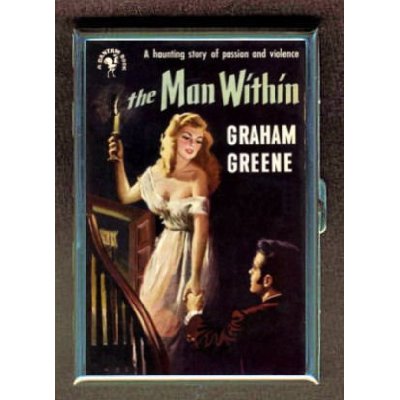
Graham Greene's The Man Within


The Man Within (1929) is Graham Greene’s first published novel. Greene was so embarrassed in later life by his first published work, a collection of poems called Babbling April, that he bought and destroyed copies wherever he could find them. He thought that his next two novels after The Man Within, The Name of the Action (1930) and Rumour at Nightfall (1931), were so bad that he steadfastly refused to allow them to be reprinted. However, Greene allowed The Man Within to be reissued in 1947 adding this Author’s Note:

“The Man Within was the first novel of mine to find a publisher. I had already written two novels, both of which I am thankful to Heinemann’s for rejecting. I began this novel in 1926 , when I was not quite twenty-two, and it was published with inexplicable success in 1929, so it has now reached the age of its author. The other day I tried to revise it for this edition, but when I had finished my sad and hopeless task , the story remained just as embarrassingly romantic, the style as derivative, and I had eliminated perhaps the only quality it possessed - its youth. So in reprinting it not a comma has been altered intentionally. Why reprint then? I can offer no real excuse, but perhaps an author may be allowed one sentimental gesture towards his own past, the period of ambition and hope.”

The Man Within is very polished and well written for the maiden effort of a young man in his early twenties. Although the book drags in the beginning, by the middle you can start to see the Greene who will be the author of Brighton Rock and The End of the Affair begin to emerge.

The Man Within is set in the late 19th century on the English coast. It is the story of Francis Andrews who is tormented by the memory of his dead father, a smuggler. Andrews hates his father for the abuse of his mother which eventually led to her death. (According to some critics, this may have been a Freudian way for Greene to explore his feelings about his own father, an English school master). While his father was alive, Andrews had been sent off to a boarding school where he learned Latin and Greek. The right hand man of Andrews’ father, Carlyon, has now become captain of the smuggling ship and convinces Andrews to come along. Whereas the other smugglers are ruffians, Carlyon is a man of culture and learning and Andrews looks up to him as a big brother figure.

Andrews eventually tires of being a smuggler and resents the constant comparison of him to his father. The crew looked up to Andrews’ father as a great man, although Andrews knows that with his wife and children he was an uncaring brute. Out of hatred for his dead father, Andrews informs the customs authorities as to where and when a shipment of smuggled goods will be landing. The smugglers get into a shoot out with law enforcement and a customs officer is killed. All but three of the smugglers are arrested and charged with murder.

Andrews flees to a rural cabin occupied by a young woman named Elizabeth. The man who Elizabeth lived with, who had taken care of her since the death of her mother, has just died. In the last years of his life, the man had made sexual advances to Elizabeth which she had rebuffed. Andrews is smitten with Elizabeth and it is a case of love at first sight.


Andrews views himself as a coward and wants to keep running from his pursuers. Elizabeth convinces Andrews to stop fleeing from the other smugglers and testify against them in Court. Andrews does this, but the townspeople are sympathetic to the smugglers and the jury acquits the Defendants. Andrews is warned that the smugglers intend to get revenge against Elizabeth for hiding Andrews out. Andrews then returns to Elizabeth’s cottage where he tries to convince her to run away with him. Elizabeth convinces Andrews to go for help. Andrews returns too late as Elizabeth has been killed by the angry smugglers. When the police arrive, Andrews is alone with Elizabeth’s body and takes the blame for killing her so that he can commit judicial suicide and join Elizabeth in death after his execution. The End.

Andrews is an insufferable emotionally tortured wimp and is not a very likeable character. He pledges undying love for Elizabeth but runs off and jumps in bed with an attractive harlot the first chance he gets and then feels guilty about it. The first half of the novel goes on interminably with Andrews swooning over Elizabeth’s good looks, moral purity and saintliness. In the second half, the book picks up speed and we start to see the Graham Greene that is to come. The portion of the novel dealing with the trial of the smugglers is tightly and skillfully written. It begins to drag again when Andrews returns to Elizabeth’s cottage, and the ending is simply stupid.


However, The Man Within does present, in embryo form, the preoccupations of Greene’s later work. Throughout the novel there is a brooding pre-occupation with death and the existence of God.

“She says there is a God, he thought, and no God could help but guard her. Yet what strange ideas of guardianship gods had, for those who were most their own they often paid with death, as though the failure of life itself was not a branch of guardianship. . . . I would rather trust to a devil to look after his own than a god, he thought, for there seemed to him nothing more final and irrevocable than death. It did not occur to him that Elizabeth’s death might be irrevocable only to him and his desire . . . If love survived the body, as church people believed, why not also jealousy, split like a bitter wine into the unhoused spirit?”

Although The Man Within is not a great novel, like every other Graham Greene novel which I have read so far, The Man Within is well worth reading.

Sunday, November 21, 2010

Evelyn Waugh's Vile Bodies


Vile Bodies (1930) is Evelyn Waugh’s second published novel. This dark comedy satirizes the “Bright Young Things,” or the young upper class partying set of the nineteen twenties. Like Fitzgerald’s The Great Gatsby, the theme of Vile Bodies is the spiritual bankruptcy and emptiness of the hedonistic lifestyle of party going and materialism. The title is based upon a verse from Saint Paul’s epistle to the Phillipians which is a part of the burial service in the Anglican Book of Common Prayer.***

The plot of Vile Bodies involves the struggle of Adam Fenwick Symes, who like Paul Pennyfeather in Decline and Fall, is a hapless victim of circumstances. Adam is engaged to marry Nina Blount. Although Nina is deeply in love with Adam, she refuses to marry him unless he is wealthy enough to maintain a certain standard of living. Adam spends the length of the book trying to make enough money to be able to marry Nina.

First, Adam, who is an aspiring writer, has the manuscript of his book confiscated by British customs as pornography when he returns to England from the continent. Since Adam had already been paid an advance by a publisher for the book, he is now deeply in debt. Then Adam manages to win a thousand pounds from gambling, but gives the money to a drunk retired army Major to bet on a horse. Nina then sends Adam to ask her father, Colonel Blount, to give him enough money to let them be married.


Evelyn Waugh

The character of Colonel Blount foreshadows Waugh’s later creation of Charles Ryder’s eccentric father in Brideshead Revisited. Nina’s father is an eccentric who sponges off of the local Anglican priest and pays a film company to make a movie about the life of John Wesley on his estate. The name of the Blount estate, Doubting Hall, is symbolic of the lack of faith in the post- World War I world. Colonel Blount pretends at first that he thinks that Adam is a vacuum cleaner salesman. Adam is ecstatic when Colonel Blount gives him a check for a thousand pounds. Adam’s euphoria is short lived when he discovers that Colonel Blount has signed the check “Charlie Chaplin.”

In order to make money, Adam takes a job as a gossip columnist, “Mr. Chatterbox,” after the suicide of the former writer. (Which, I must add, has to be one of the funniest suicides in the history of English literature). In order to fill his column, Adam begins making up things about imaginary people and inventing fashion fads. When Adam says that the latest thing is black suede shoes worn with a tuxedo, fashionable men among “the Bright Young Things” all run out and get black suede shoes. Adam is finally fired from his job when he tries to start a fad of bottle green bowler hats.

At the same time as she is breaking her engagement with him, Nina begins sleeping with Adam. Eventually, Nina becomes engaged to Ginger Littlejohn, a wealthy childhood friend. Nina is not in love with Ginger but is marrying him solely for his money, so she continues to sleep with Adam. After being confronted by Ginger, Adam sells Nina to Ginger for the price of his hotel bill which he cannot pay.

In this novel, Waugh predicts the coming of the Second World War. When political tensions in Europe increase, Ginger is called up to his regiment and Nina takes Adam home for Christmas and introduces him as her rich husband, Captain Littlejohn. So pretending to be Ginger, Adam spends the holidays taking Ginger’s place in Nina’s bed. Although the servants and the Rector are suspicious, the Colonel apparently doesn’t know the difference. The novel ends with Adam lost on “the world’s biggest battlefield,” where he finally finds the drunk Major, who is now a General. The Major writes Adam a check for thirty four thousand pounds, which, after inflation, will now buy him “a couple of drinks and a newspaper.” Nina writes Adam that although she is pregnant with Adam’s baby, she is happily married to Ginger who is convinced that the baby is his.


All through the novel, Adam attends one fashionable party after another:

“Masked parties, Savage parties, Victorian parties, Greek parties, Wild West parties, Russian parties, Circus parties, parties where one had to dress as somebody else, almost naked parties in St. John’s Wood, parties in flats and houses and shops and hotels and night clubs, in windmills and swimming baths . . . all that succession and repetition of mass humanity - Those vile bodies.”

According to Humphrey Carpenter’s book The Brideshead Generation, Waugh was writing Vile Bodies as his first marriage to Evelyn Gardner (“she Evelyn”) was breaking up. According to Carpenter, sexual dysfunction contributed to the break up. After Adam and Nina’s first night together, Nina remarks, “All this fuss about sleeping together. For physical pleasure I’d sooner go to my dentist any day.”


Vile Bodies is filled with eccentric characters. There is Mr. Outrage, the Prime Minister, who is baffled about the conversations at cabinet meetings which he doesn’t understand. The government of his predecessor is brought down when the Prime Minister’s daughter, one of the “Bright Young Things,” brings a group of her friends home and the press reports that wild parties have been going on at Number Ten Downing Street.

There is Mrs. Melrose Ape, the American evangelist ( a thinly veiled Amy Semple McPherson), who has a choir of young women dressed as angels and named after the virtues. Unfortunately, Chastity is the most promiscuous of the bunch and eventually winds up becoming a prostitute. (At the end of the novel, the drunk Major, who is now a General, is making love to Chastity in the back of his staff car in the middle of a battle).

There is the homosexual Miles Malpractice and the lesbian Lady Agatha Runcible who dies in a mental hospital after taking over for a disabled race car driver and wrecking the car (aptly numbered car number 13).


Adam’s hotel is full of eccentric characters including a European king who lost his throne after the World War, an American Federal Court Judge who has a drunk prostitute die in his room when she falls from swinging on the chandelier, and the Major who takes Adam’s money. The hotel owner, Lottie Crump, is based upon Rosa Lewis who owned the Cavendish hotel in London and had, during the Edwardian era, provided discreet accommodations for the male aristocracy and their extra-marital female and homosexual companions.

The character of the Jesuit Priest, Father Rothschild, who opines that the young people are desperately in search of permanent values, exists in the novel as a kind of Greek chorus. (Shortly after the publication of this novel, Waugh converted to Catholicism). Vile Bodies contains one joke and outrageous situation after another. Although the particular scenes and situations are contrived, over blown, and ridiculous, the over arching theme of the spiritual bankruptcy of hedonism and materialism presents serious food for thought for our own age.


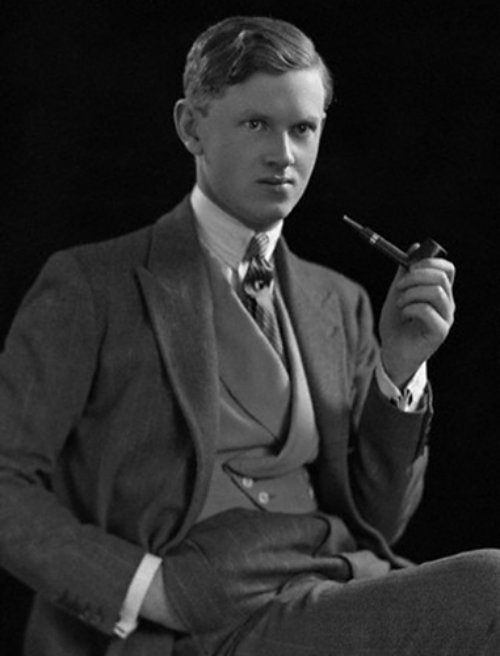
The youthful Evelyn Waugh

***“Forasmuch as it hath pleased Almighty God of his great mercy to take unto himself the soul of our dear brother here departed: we therefore commit his body to the ground; earth to earth, ashes to ashes, dust to dust; in sure and certain hope of the Resurrection to eternal life, through our Lord Jesus Christ; who shall change our vile body, that it may be like unto his glorious body, according to the mighty working, whereby he is able to subdue all things to himself.”