Showing posts with label Hardboiled Crime Fiction. Show all posts

Saturday, January 25, 2014

THE GETAWAY


This is not my first Jim Thompson novel.  A number of years ago I read The Killer Inside Me, which, along with Brett Easton Ellis’ American Psycho, ranks with the top ten novels which have tried to get within the mind of a psychopathic serial killer.

The book presently under consideration is, perhaps, Thompson’s most famous and infamous novel.  Famous because of the two Hollywood adaptations of it, and infamous because of the allegorical surrealist ending which has both intrigued and baffled readers for decades.


The Getaway (1958) begins as a conventional crime novel about a bank robbery.  The robbery happens at the very beginning of the book.  The mastermind, Carter “Doc” McCoy, has recently been released from prison after Doc’s wife, Carol, seduced and bribed the parole board chairman. Doc has been holed up in a seedy hotel casing an isolated bank in a rural town.  Except for killing a bank guard with a long distance rifle shot, Doc is not doing the dirty work himself.   Ace thug Rudy Torrento and his young side kick have been assigned to actually rob the bank.


Just about everybody in The Getaway is out for themselves.  Rudy kills the young side kick, then Doc tries to knock off Rudy to get him out of the way.  After Doc plugs Rudy, Carol is waiting to pick him up and haul ass.


Of course, everything goes wrong.  Rudy survives being shot by Doc and kidnaps a veterinarian and his wife. The wife goes crazy for Rudy and the milquetoast husband commits suicide.  It seems to be a theme in The Getaway that girls love the bad boys.  We learn that before meeting Doc, Carol was a homely librarian. Doc swept her off her feet and she eagerly joined Doc in his life of crime, even being disowned by her parents.

So Doc and Carol haul ass across the country with the loot being pursued by both the police and Rudy Tarrento.  As Carol and Doc flee, the body count continues to mount up.  In fact, it is alluded to that Doc and Carol have killed more people during their getaway than is directly recounted.  Anybody that gets in their way or is an inconvenient witness is ruthlessly eliminated.


Finally Rudy and his new girlfriend catch up to Doc and Carol in a Southern California Motel.  Doc kills both of them and he and Carol must again run like hell.

DON’T GO TO EL REY!


Here’s where things start getting weird.  A lot of crime fiction aficionados don’t like the surrealist ending of The Getaway.  I think that the ending is what makes this novel special.  After all there’s a reason that a book published as a throw away pulp fiction paperback in the late 1950s is still in print and we are still reading it and talking about it.

Doc and Carol are headed for sanctuary in the Kingdom of El Rey which is described as a hideaway for fugitives in Mexico.  El Rey, which means “The King” in Spanish, has lavish first class accommodations.  In fact, residents are required to pay for first class accommodations, because they wanted everything first class in their previous lives.  However, when your money runs out, you are banished to an outlying village.  There is no food from the outside allowed in the village.  The residents exiled from El Rey survive by cannibalizing each other.  Therefore, couples who seek refuge in El Rey usually wind up murdering the other partner to conserve cash.  That is, the ones who don’t commit suicide out of despair.  So, in the midst of first class villas by the sea and unlimited gourmet food and drink, everyone in El Rey is miserably awaiting their ultimate demise.

Obviously, all of this is not to be taken literally.  Because it is a radical departure from the realism of the rest of the book, a lot of readers over years have despised the ending.  I think that the allegory really begins before the fleeing couple get to El Rey.  After killing Rudy and his girlfriend, Doc and Carol flee in a stolen taxi.  Facing certain capture, they are rescued by crime family matriarch Ma Santis.  Ma Santis hides the couple out first in underwater caves where the space is no bigger than a coffin and then in a lean-to hidden in a manure pile.

This entire episode is heavy with symbolism.  Doc and Carol have to strip naked and dive into a water filled pit to get to the cave hideaway.  The rooms in the caves are just big enough to lie down in and Doc and Carol are separated by a wall of rock.  Obviously, this represents death and the grave.

Then after coming up from the pit, Doc and Carol hide out in a lean two hidden inside a pile of cow manure. During the day, they are faced with swarms of flies and worms.  It’s not difficult to figure out that this represents that, although still technically alive, Doc and Carol are decaying corpses.

Then Ma Santis arranges for Carol and Doc to be taken to Mexico by a Portuguese fishing boat Captain. The body count again mounts up when they have to kill the crew of a Coast Guard Patrol Boat.  I think that the boat ride represents the ferrying of the dead across the River Stix to the underworld in Greek mythology.

El Rey is the Devil and his Kingdom is Hell.  For a novel that is a fast paced conventional crime novel until 2/3 of the way through, all of this symbolism and allegory has been tough for a lot of readers to take.


Steve McQueen fired Thompson from writing the screenplay for his movie version of The Getaway, and totally jettisoned the El Rey ending.  In McQueen’s movie version, Doc and Carol apparently escape into Mexico to live happily ever after.  But “happy ever after” is a really boring ending isn’t it?  And don’t Doc and Carol deserve to go to hell after the blood trail that they’ve left behind them?  If Thompson had written an ending where Doc and Carol were captured and went to the Gas Chamber together, there would be the possibility of redemption through suffering.  As it is, they get away to the place where they deserve to be and there is no possibility of redemption.

Interestingly, at one point in the novel, Doc and Carol hide out a with a group of migrant farm workers. Here among the poorest of the poor, Doc is happy.  The novel indicates that Doc would have been content to stay with them forever.  The irony is that Doc is happiest when he is with poor people who have nothing.  When he reaches El Rey and has every material comfort, he is the most miserable.  Be careful what you want, you might get it.


The Quentin Tarantino - Robert Rodriguez movie From Dusk Til Dawn follows the pattern of The Getaway.  It begins as a conventional crime story involving the Gecko brothers, George Clooney and Quentin Tarantino, fleeing from a robbery.  Just like in The Getaway, they’re headed for El Rey.  Half way through the movie, it becomes a horror film when the brothers stop off at a Mexican strip club run by vampires.  On the commentary track, Tarantino talks a lot about the Kingdom of El Rey.  Tarantino is a big fan of Jim Thompson and The Getaway.

So if there’s one thing to take away from The Getaway, it’s “Don’t Go To El Rey!”


.

Jim Thompson (1906 - 1977)

Saturday, August 27, 2011

James M. Cain's DOUBLE INDEMNITY


“I stared into the darkness some more that night. I had killed a man, for money and a woman. I didn’t have the money and I didn’t have the woman. The woman was a killer, out-and-out, and she had made a fool of me. She had used me for a cat’s paw so she could have another man, and she had enough on me to hang me higher than a kite. . . . I got to laughing, a hysterical cackle, there in the dark.” So James M. Cain’s character Walter Huff explains his dilemma in the crime noir classic Double Indemnity.


Following up on his run away commercial success with The Postman Always Rings Twice, Double Indemnity was written as a serial for Liberty Magazine. According to The Encyclopedia of Pulp Fiction Writers, Double Indemnity “. . . was meant to be a quickie job that Cain vowed would never be reprinted as a book. While researching Postman, Cain had talked to some insurance investigators, and with another real-life crime for inspiration he wrote a story about a woman conspiring with an insurance salesman to kill her husband and collect on his policy.” Double Indemnity originally appeared as a serial in Liberty Magazine in 1936, and, despite Cain’s initial reservations, was published in hardcover with two other of Cain’s novellas in 1943.


Although Cain has been accused of merely writing a re-hash of Postman, I found Double Indemnity to be a much darker tale. The main characters of Double Indemnity, Walter Huff and Phyllis Nordlinger, are much more evil than Frank Chambers and Cora Papadakis, the murdering adulterers of The Postman Always Rings Twice. Whereas Postman’s Frank Chambers just kind of falls into murder, Walter Huff knows that Phyllis wants to kill her husband and is more than willing to cooperate for a cut of a $50,000 accidental death policy. Frank and Cora murder solely for love/lust. Walter and Phyllis murder for money. Whereas Frank Chambers is a drifter and a loser and Cora Papadakis is a bored house wife, Walter Huff is a successful insurance salesman with a desire to cheat the insurance company and Phyllis Nirdlinger turns out to be a serial killer.


Walter Huff met Phyllis Nirdlinger when he went to the Nirdlinger home to see oil company executive H.D. Nirdlinger about renewing his automobile insurance. Huff makes his sales pitch to Mrs. Nirdlinger who has come downstairs in her pajamas:


“Under those blue pajamas was a shape to set a man nuts . . .

But all of sudden she looked at me, and I felt a chill creep straight up my back and into the roots of my hair. “Do you handle accident insurance?”

Maybe that don’t mean to you what it meant to me. Well, in the first place, accident insurance is sold, not bought. You get calls for other kinds, for fire, for burglary, even for life, but never for accident. The stuff moves when agents move it, and it sounds funny to be asked about it. In the second place, when there’s dirty work going on, accident is the first thing they think of. . . . there’s many a man walking around today that’s worth more to his loved ones dead than alive, only he don’t know it yet.”


Walter and Phyllis conspire to have Phyllis’ husband take out an accidental death policy and murder him for the insurance money. Nirdlinger believes that he is signing a renewal for his automobile insurance when he is really signing an application for accidental death insurance. The $25,000 policy has a double indemnity clause for dying in a railroad accident, so Walter devises a plan to make it look like Mr. Nordlinger fell off of a train and broke his neck. When Nirdlinger has a real accident and breaks his leg, he can no longer drive to a class reunion he planned to attend and Phyllis convinces him to take the train. Walter kills Mr. Nirdlinger by breaking his neck and then, posing as Nirdlinger and wearing a cast on his foot and hobbling on crutches, Walter boards the train and jumps off the observation platform. Phyllis drives the body to the spot where Walter jumped off the train where they deposit the victim’s body. Phyllis and Walter have iron clad alibis and it appears that Nirdlinger genuinely broke his neck falling off the train.


However, Barton Keyes, the claims investigator for the insurance company (brilliantly played by Edward G. Robinson in the 1944 movie version), is convinced that Nirdlinger has been murdered. Keyes, however, is also convinced that Walter Huff is a dedicated insurance man and confides in him. Huff, of course, uses the information to avoid detection.


Walter is redeemed when he falls in love with Nirdlinger’s step daughter, Lola. Phyllis was a nurse. Lola’s mother was related to a child which Phyllis was caring for in the hospital. The child was the heir to a large sum of money and property. This child and two others died in mysterious circumstances in the hospital under the care of Phyllis. Lola’s mother then inherited the fortune. Lola tells Walter that she suspects that Phyllis murdered her mother. Shortly after her mother’s death, Phyllis married Lola’s father.


The plot is rather complex, with Lola’s boyfriend being the son of a doctor who was ruined by Phyllis who pretends to dump Lola and seduce Phyllis seeking to get evidence against her. Walter decides that he must murder Phyllis in order to protect himself but is double crossed when Phyllis shoots him in the chest and Lola and her boyfriend are wrongfully accused of the crime.


Because of his love for Lola, Walter decides to confess to his friend Keyes, the insurance investigator. There is then an elaborate plot by the insurance company executives and lawyers to minimize bad publicity by avoiding a criminal trial. Walter and Phyllis flee the country on board a ship paid for by the insurance company.


The ending of Double Indemnity is chilling as Walter and Phyllis join each other in a suicide pact:

“There’s nothing ahead of us, is there Walter?

No. Nothing. . . .

“. . . Walter, the time has come.”

“What do you mean, Phyllis?”

“For me to meet my bridegroom. The only one I ever loved. One night I’ll drop off the stern of the ship. Then, little by little I’ll feel his icy fingers creeping into my heart.”

“. . . I’ll give you away.”

“What?”

“I mean: I’ll go with you.”

“It’s all that’s left, isn’t it?”

. . . I’m writing this in the stateroom. It’s about half past nine. She’s in her stateroom getting ready. She’s made her face chalk white, with black circles under her eyes and red on her lips and cheeks. . . . She looks like what came aboard the ship to shoot dice for souls in the Rime of the Ancient Mariner.”


Barbara Stanwyck as Phyllis and Fred MacMurray as Walter

The 1944 movie version of Double Indemnity, starring Fred MacMurray as Walter and Barbara Stanwyck as Phyllis, is considered to be a classic of the film noir genre. It was directed by legendary director Billy Wilder who co-wrote the screenplay along with famed “hard-boiled” detective writer Raymond Chandler. As a personal note, the first time I saw Double Indemnity, I was home sick and watching it on AMC. There was a real estate closing involving some investment property that was scheduled for that day. My wife showed up with a secretary to get me to sign a power of attorney to allow her to act for me at the closing. After just watching Fred MacMurray obtain the signature of his victim on an accidental death policy he thought was his car insurance renewal, I was just a little reluctant to sign.


The novella Double Indemnity is a classic of the Crime Noir genre and should continue to be read and enjoyed well into the future.


WHAT IS CRIME NOIR?

From the Foward “James M. Cain - Father of Noir” in James M. Cain: Hard-Boiled Mythmaker by David Madden (Scarecrow Press, 2011):

“So now we come to the term "noir". Originally this was a word used by French film critics to discuss American crime films whose subject matter was dark and whose lighting effects, courtesy of German expressionism, was darker. Many of these were cheap B movies, where a master of cinematography like John Alton could hide the lack of proper art design and set direction by “painting with light.” Among the most influential of the bigger-budget films noir was Wilder’s "Double Indemnity".

French film critics using the term film noir were referencing the "Serie noire", a line of crime novels published by Gallimard - black covered paperbacks reprinting Cain and other American writers, many of whom were his imitators. Gallimard began the "Serie noire" in the forties, and it continues to this day. . . .

In the sixties, American film critics . . . began using the term film noir, and in the subsequent decades it has been so basterdized as to be almost meaningless. Most critics agree that noir films date from around 1941 to 1955, have dark subject matter and atmospheric lighting, and are in black-and-white. Subsequent crime films of a noirish nature - like the definitive Cain patische, "Body Heat" - are usually called neo-noir.

In recent years, in American publishing the term "hard-boiled" has become tarnished due to its old-fashioned ring (it’s a World War I term, after all, pertaining to tough top sergeants), and “tough guy” is even more unpopular and antiquated. . . .

Just as American film critics co-opted the term film noir from the French, American book critics (and editors and publishers and even authors) appropriated it to describe that which mustn’t be termed "hard boiled". . . .

Vague as it is, noir as a definition or perhaps category has pushed out “hard-boiled,” a term Cain hated. So it’s time to remind everyone that James M. Cain, in "The Postman Always Rings Twice" and his next several novels, defined and perfected the dark crime novel, which gave birth to the films named after the French book series of which Cain was a major part and prime influence.

Without Cain, there is - no matter how you define it - no noir.

He is its daddy.

And he was very, very strict.”


Thursday, August 25, 2011

THE POSTMAN ALWAYS RINGS TWICE


“They threw me off the haytruck about noon.” So begins one of the most famous crime noir novels of all time, The Postman Always Rings Twice.

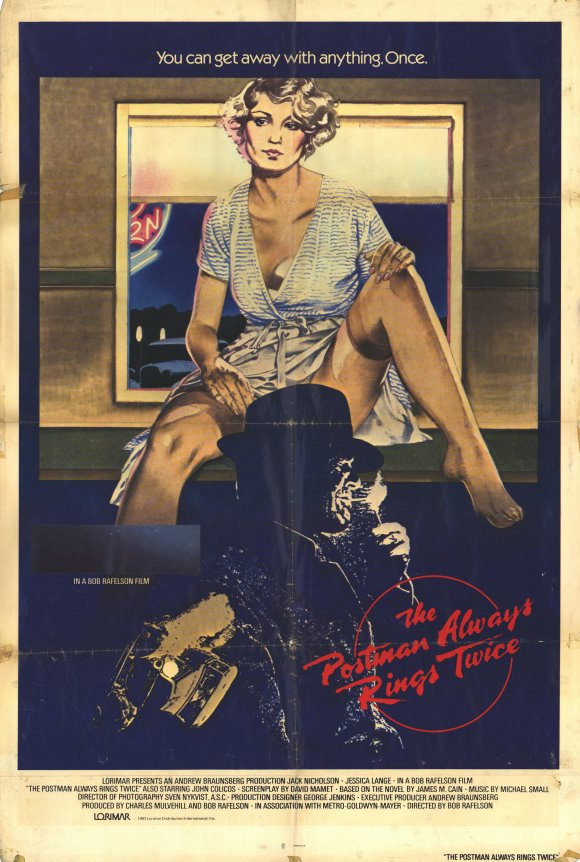
Neither of the two movies, neither the 1946 Lana Turner - John Garfield version nor the 1981 Jessica Lange - Jack Nicholson version, really do this book justice, although the Lange - Nicholson movie follows the novel much more closely. The “hard boiled” style has now been parodied so much that it is hard to realize how new and fresh this writing was in 1934 when Postman was first published.


The plot of Postman is well known. Frank Chambers is a no good drifter who lands at the Twin Oaks Tavern which, as Frank describes it, “ . . . was nothing but a roadside sandwich joint, like a million others in California. There was a lunchroom part, and over that the house part, where they lived, and off to one side a filling station, and out back a half dozen shacks that they called an auto court.”


The Twin Oaks Tavern is owned by a middle aged Greek immigrant named Nick Papadakis and his pretty young wife Cora. Cora won a beauty contest in Iowa and came to Hollywood trying to break into the movie business. Although Cora’s looks may have been enough to make her a silent movie star, the recent advent of talking pictures has doomed any chance Cora has of being a movie star.

“They gave me a test. It was all right in the face. But they talk, now. The pictures, I mean. And when I began to talk, up there on the screen, they knew me for what I was, and so did I. A cheap Des Moines trollop that had as much chance in pictures as a monkey has. A monkey, anyway, can make you laugh. All I did was make you sick.”


After washing out in the movies, Cora is forced to wait tables in seedy dives. Cora has married “the Greek” for financial reasons. Although the Greek is a likeable man who works hard and treats Cora well, Cora does not love him and is not sexually excited by him. When the Greek offers Frank the drifter a job working in the gas station, Frank takes it with the idea of trying to seduce Cora. Being bored in her marriage, Cora is easily seduced. There is just a hint of Sado-Masochism in the first sexual encounter between Cora and Frank:


“I took her in my arms and mashed my mouth up against hers . . . “Bite me! Bite me!”

I bit her. I sunk my teeth into her lips so deep I could feel the blood spurt into my mouth. It was running down her neck when I carried her upstairs.”


This was very racy stuff in 1934. Lines like this and “She looked like the great-grandmother of every whore in the world,” caused this book to be considered scandalous in its time and caused it to be one of those books which was “banned in Boston.”


In any event, Cora and Frank conspire to murder the Greek. Actually it’s more Cora than Frank. Even though Frank is a loser and an ex-con, he is a likeable character. After staying with Frank’s first person narration for the whole novel, the reader comes to feel that Frank is an old friend. Frank is reluctant to kill Nick when Cora first suggests it:

“. . . I’ve made one mistake. And I’ve got to be a hell cat, just once, to fix it. But I’m not really a hell cat, Frank.”

“They hang you for that.”

“Not if you do it right. You’re smart, Frank. I never fooled you for a minute. You’ll think of a way. Plenty of them have. Don’t worry. I’m not the first woman that had to turn hell cat to get out of a mess.”

“He never did anything to me. He’s all right.”

“The hell he’s all right. He stinks, I tell you. He’s greasy and he stinks. And do you think I’m going to let you wear a smock, with Service Auto Parks printed on the back, Thank-U Call Again, while he has four suits and a dozen silk shirts? Isn’t that business half mine? Don’t I cook? Don’t I cook good? Don’t you do your part?”

“You talk like it was all right.”

“Who’s going to know if it’s all right or not, but you and me?”

“You and me.”


Jack Nicholson and Jessica Lange as Frank Chambers and Cora Papadakis

Cora is really the ruthless one with the least moral scruples. Even though he becomes a cold blooded killer, Frank does seem to have a certain morality about him. Cora is eager to kill the Greek but Frank is a reluctant killer. “He never did anything to me. He’s all right.” But Frank’s lust for sexy Cora outweighs Frank’s scruples.

Jessica Lange as Cora and John Colicos as "the Greek"

This novel is so well known, I feel no need to go through the entire plot in detail. Having been a lawyer in criminal courts for over twenty years, I felt that the courtroom and legal scenes in The Postman Always Rings Twice are very realistic. I noticed that in the 1981 Jack Nicholson movie, the name of the conniving criminal defense lawyer, Katz, had been changed to something less Jewish sounding. I wonder if it was felt that Cain was making an anti-semitic swipe against “Jewish lawyers,” since Katz is interested only in making a big splash and winning his case and has no interest in justice whatsoever.


Since author James M. Cain was writing a morality tale, he couldn't allow the murderers to live happily ever after. Just when it looks like Frank and Cora are really going to settle down and have babies disaster strikes. After having gotten away with murdering the Greek, Frank is wrongfully convicted of murdering pregnant Cora after she dies in a tragic accident while Frank was trying to rush her to the hospital. The novel ends with Frank on death row about to be executed for the murder he didn’t commit.


According to The Encyclopedia of Pulp Fiction Writers “Dashiell Hammett, Raymond Chandler, and James M. Cain are the father, son, and holy ghost of American hard-boiled literature.” Prior to authoring Postman, Cain was a successful journalist and a not so successful playwright and screenwriter.

James M. Cain

Reportedly, the inspiration for Postman was the Ruth Snyder - Judd Grey case where an adulterous couple conspired and murdered the woman’s husband. There is a famous picture covertly snapped by a reporter of Ruth Snyder dying in New York’s electric chair.

The infamous photograph of the execution of Ruth Snyder

The title has always caused some confusion since there is no postman in the story. Cain had originally named the story “Bar-B-Que” but the publisher, Alfred A. Knopf, wanted another title. The “Postman” who “always rings twice,” is God or fate. Frank and Cora got away with murder the first time, but then the postman came back and delivered punishment.

Lana Turner and John Garfield as Cora Papadakis and Frank Chambers

Although Cain continued to write novels up until his death in 1977, he never recaptured the run away success of The Postman Always Rings Twice. His next novel, Double Indemnity (1943), is basically a re-hash of the same story, involving this time an insurance salesman and the wife of a client.


The Postman Always Rings Twice is short, only 35,000 words. Apparently, Knopf had to print it in larger than normal type to make it look like it was longer. As one article which I read on the internet said, “It will take you longer to watch either movie version than to read the book.” Even after all these years, The Postman Always Rings Twice is still able to work its magic on readers. It is still a powerful, gripping story and the sparse, muscular Hemingway-esque “hard-boiled” style can still grab you. The Postman Always Rings Twice well deserves its reputation as a classic.