Showing posts with label Evelyn Waugh. Show all posts

Saturday, November 27, 2010

Evelyn Waugh's Labels


In 1929 Evelyn Waugh was a struggling young writer. He was also a newlywed. Waugh’s marriage to Evelyn Gardner, whom Waugh’s friends called “she Evelyn,” was strongly disapproved of by Gardner’s mother, Lady Burghclere. Waugh’s first novel, Decline and Fall, had met with some success and Waugh’s agent had gotten Evelyn and Evelyn free passage on a cruise ship in exchange for a promise to write a travel book. The result was Labels: A Mediterranean Journey.

“I have called this book Labels for the reason that all the places I visited on this trip are already fully labeled. I was no adventurer of the sort who can write books with such names as Off the Beaten Track in Surrey or Plunges into Unknown Herts. I suppose there is no track quite so soundly beaten as the Mediterranean seaboard; no towns so constantly and completely overrun with tourists as those I intend to describe.”

The first thing to note about Labels is that it is partly fiction. Throughout the book, Waugh maintains the pretense that he traveled alone, when, in fact, he was on his honeymoon. The book was even published in the United States as A Bachelor Abroad. Waugh invents a newlywed English couple, Geoffrey and Juliet, whom he is supposed to have befriended during his trip. In fact, Geoffrey and Juliet are Mr. and Mrs. Evelyn Waugh.

During the early stages of the trip, before even boarding the cruise ship, she-Evelyn began running a high fever and eventually developed double pneumonia. She-Evelyn was so critically ill that Waugh did not expect her to survive. Upon arriving in Egypt, she-Evelyn was immediately taken to a hospital. In Labels, Waugh maintains the pretense of helping “Geoffrey” with the care of “Juliet”:

“The only disturbing element in this happy week was Juliet, who was by this time very seriously ill. The doctor pronounced her unfit for travel, and she was accordingly lowered in a stretcher and taken ashore to the British hospital. I accompanied the procession, which consisted of the ship’s doctor, carrying warm brandy and a teaspoon, an officer, Geoffrey, half distracted with anxiety, a dense mob of interested Egyptians, Copts, Arabs, Lascars, and Sudanese, and a squad of ambulance men, two of whom fought the onlookers while the others bundled Juliet - looking distressingly like a corpse - into a motor van.”

Since Decline and Fall had been a comic novel, Waugh was expected to be funny. One of the things that I love about Waugh is that he was an old curmudgeon even when he was only 27 years old. Waugh is wonderfully eccentric. Of course, there is no political correctness in anything written by Evelyn Waugh:

“Living as we are under the impact of the collective inferiority complex of the whole West, and humbled as we are by the many excellencies of Chinese, Indians, and even savages, we can still hold up our heads in the Mohammedan world with the certainty of superiority. It seems to me that there is no single aspect of Mohammedan art, history, scholarship, or social, religious, or political organisation, to which we, as Christians, cannot look with unshaken pride of race.”

In what I would have imagined was pretty racy stuff for 1929 (but maybe not, after all this was the “Roaring Twenties”), Waugh describes how he checked out the red light district in Port Said and Cairo, Egypt. Of course, Waugh states that he and his companion, an English solicitor who knew where to find all the brothels, merely checked out the girls and drank beer with the madam.

In Waugh’s view, Americans rank somewhere just above unwashed savages. He laughs at a group of American tourists in Egypt who pay to see some cave where sacred bulls were buried:

“Oh, ladies and gentlemen, I longed to declaim, dear ladies and gentlemen, fancy crossing the Atlantic Ocean, fancy coming all this way in the heat, fancy enduring all these extremities of discomfort and exertion; fancy spending all this money, to see a hole in the sand where, three thousand years ago, a foreign race whose motives must forever remain inexplicable interred the carcasses of twenty-four bulls. Surely the laugh, dear ladies and gentlemen, is on us. But I remembered I was a gate-crasher in this party and remained silent.”


Waugh says this of a wealthy American touring the former sultan’s palace in Istanbul, Turkey:

“Immediately in front of me in our tour of inspection there travelled a very stout, rich lady from America, some of whose conversation I was privileged to overhear. Whatever the guide showed her, china, gold, ivory, diamond or amber, silk or carpet, this fortunate lady was able casually to remark that she had one like that at home. “Why,” she would say, “whoever would have thought that was of any value. I’ve got three just like that, that Cousin Sophy left me, bigger, of course, but just the same pattern, put away in one of the store-rooms. I must have them out when I get back. I never looked on them as being anything much.” But she had to admit herself beaten by the right hand and skull of St. John the Baptist.”


Labels is a description of people during the twilight of the old British Empire traveling through a world which was the Englishman’s oyster. It is easy to become nostalgic about a world “where the sun never set on the Union Jack.” Waugh would live to see this world come crashing down in the flames of the Second World War and its aftermath. Labels remains an entertaining and enlightening account of travel through the world of a bygone age.
Sunday, November 21, 2010

Evelyn Waugh's Vile Bodies


Vile Bodies (1930) is Evelyn Waugh’s second published novel. This dark comedy satirizes the “Bright Young Things,” or the young upper class partying set of the nineteen twenties. Like Fitzgerald’s The Great Gatsby, the theme of Vile Bodies is the spiritual bankruptcy and emptiness of the hedonistic lifestyle of party going and materialism. The title is based upon a verse from Saint Paul’s epistle to the Phillipians which is a part of the burial service in the Anglican Book of Common Prayer.***

The plot of Vile Bodies involves the struggle of Adam Fenwick Symes, who like Paul Pennyfeather in Decline and Fall, is a hapless victim of circumstances. Adam is engaged to marry Nina Blount. Although Nina is deeply in love with Adam, she refuses to marry him unless he is wealthy enough to maintain a certain standard of living. Adam spends the length of the book trying to make enough money to be able to marry Nina.

First, Adam, who is an aspiring writer, has the manuscript of his book confiscated by British customs as pornography when he returns to England from the continent. Since Adam had already been paid an advance by a publisher for the book, he is now deeply in debt. Then Adam manages to win a thousand pounds from gambling, but gives the money to a drunk retired army Major to bet on a horse. Nina then sends Adam to ask her father, Colonel Blount, to give him enough money to let them be married.


Evelyn Waugh

The character of Colonel Blount foreshadows Waugh’s later creation of Charles Ryder’s eccentric father in Brideshead Revisited. Nina’s father is an eccentric who sponges off of the local Anglican priest and pays a film company to make a movie about the life of John Wesley on his estate. The name of the Blount estate, Doubting Hall, is symbolic of the lack of faith in the post- World War I world. Colonel Blount pretends at first that he thinks that Adam is a vacuum cleaner salesman. Adam is ecstatic when Colonel Blount gives him a check for a thousand pounds. Adam’s euphoria is short lived when he discovers that Colonel Blount has signed the check “Charlie Chaplin.”

In order to make money, Adam takes a job as a gossip columnist, “Mr. Chatterbox,” after the suicide of the former writer. (Which, I must add, has to be one of the funniest suicides in the history of English literature). In order to fill his column, Adam begins making up things about imaginary people and inventing fashion fads. When Adam says that the latest thing is black suede shoes worn with a tuxedo, fashionable men among “the Bright Young Things” all run out and get black suede shoes. Adam is finally fired from his job when he tries to start a fad of bottle green bowler hats.

At the same time as she is breaking her engagement with him, Nina begins sleeping with Adam. Eventually, Nina becomes engaged to Ginger Littlejohn, a wealthy childhood friend. Nina is not in love with Ginger but is marrying him solely for his money, so she continues to sleep with Adam. After being confronted by Ginger, Adam sells Nina to Ginger for the price of his hotel bill which he cannot pay.

In this novel, Waugh predicts the coming of the Second World War. When political tensions in Europe increase, Ginger is called up to his regiment and Nina takes Adam home for Christmas and introduces him as her rich husband, Captain Littlejohn. So pretending to be Ginger, Adam spends the holidays taking Ginger’s place in Nina’s bed. Although the servants and the Rector are suspicious, the Colonel apparently doesn’t know the difference. The novel ends with Adam lost on “the world’s biggest battlefield,” where he finally finds the drunk Major, who is now a General. The Major writes Adam a check for thirty four thousand pounds, which, after inflation, will now buy him “a couple of drinks and a newspaper.” Nina writes Adam that although she is pregnant with Adam’s baby, she is happily married to Ginger who is convinced that the baby is his.


All through the novel, Adam attends one fashionable party after another:

“Masked parties, Savage parties, Victorian parties, Greek parties, Wild West parties, Russian parties, Circus parties, parties where one had to dress as somebody else, almost naked parties in St. John’s Wood, parties in flats and houses and shops and hotels and night clubs, in windmills and swimming baths . . . all that succession and repetition of mass humanity - Those vile bodies.”

According to Humphrey Carpenter’s book The Brideshead Generation, Waugh was writing Vile Bodies as his first marriage to Evelyn Gardner (“she Evelyn”) was breaking up. According to Carpenter, sexual dysfunction contributed to the break up. After Adam and Nina’s first night together, Nina remarks, “All this fuss about sleeping together. For physical pleasure I’d sooner go to my dentist any day.”


Vile Bodies is filled with eccentric characters. There is Mr. Outrage, the Prime Minister, who is baffled about the conversations at cabinet meetings which he doesn’t understand. The government of his predecessor is brought down when the Prime Minister’s daughter, one of the “Bright Young Things,” brings a group of her friends home and the press reports that wild parties have been going on at Number Ten Downing Street.

There is Mrs. Melrose Ape, the American evangelist ( a thinly veiled Amy Semple McPherson), who has a choir of young women dressed as angels and named after the virtues. Unfortunately, Chastity is the most promiscuous of the bunch and eventually winds up becoming a prostitute. (At the end of the novel, the drunk Major, who is now a General, is making love to Chastity in the back of his staff car in the middle of a battle).

There is the homosexual Miles Malpractice and the lesbian Lady Agatha Runcible who dies in a mental hospital after taking over for a disabled race car driver and wrecking the car (aptly numbered car number 13).


Adam’s hotel is full of eccentric characters including a European king who lost his throne after the World War, an American Federal Court Judge who has a drunk prostitute die in his room when she falls from swinging on the chandelier, and the Major who takes Adam’s money. The hotel owner, Lottie Crump, is based upon Rosa Lewis who owned the Cavendish hotel in London and had, during the Edwardian era, provided discreet accommodations for the male aristocracy and their extra-marital female and homosexual companions.

The character of the Jesuit Priest, Father Rothschild, who opines that the young people are desperately in search of permanent values, exists in the novel as a kind of Greek chorus. (Shortly after the publication of this novel, Waugh converted to Catholicism). Vile Bodies contains one joke and outrageous situation after another. Although the particular scenes and situations are contrived, over blown, and ridiculous, the over arching theme of the spiritual bankruptcy of hedonism and materialism presents serious food for thought for our own age.


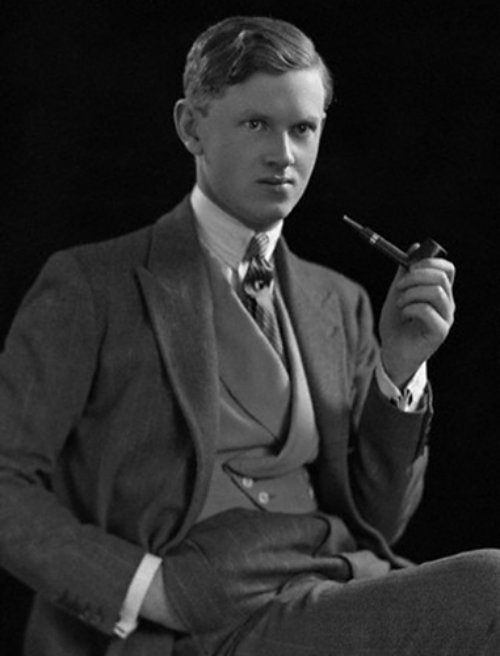
The youthful Evelyn Waugh

***“Forasmuch as it hath pleased Almighty God of his great mercy to take unto himself the soul of our dear brother here departed: we therefore commit his body to the ground; earth to earth, ashes to ashes, dust to dust; in sure and certain hope of the Resurrection to eternal life, through our Lord Jesus Christ; who shall change our vile body, that it may be like unto his glorious body, according to the mighty working, whereby he is able to subdue all things to himself.”

Saturday, October 2, 2010

Evelyn Waugh's Decline and Fall


Decline and Fall is Evelyn Waugh's first novel published in 1928. Before the publication of his great Catholic novel Brideshead Revisited, Waugh was best known as a satirist. Decline and Fall is a comic novel which makes fun of English upper class and middle class society.

The protagonist, Paul Pennyfeather, is "sent down" (expelled) from Oxford University for "indecent behavior" when a group of rowdy students steal his pants. Like Waugh and many other university educated young men in the twenties, the only job Paul can find is teaching at a third rate school.

The school, Llnabba, is located in Wales, and Waugh spares no opportunity to make fun of the Welsh. At Llnabba, Paul encounters a group of eccentrics who have landed there after failing at other jobs. There is Captain Grimes, who was sentenced to be shot for cowardice in World War I, but got re-assigned to Ireland because it was bad form to shoot another public school man. Mr. Prendergast is a former clergyman in the Church of England who left the ministry because he stopped believing in God. However, his bishop didn't think it was a problem because it didn't affect his day to day duties as a parish priest.


Evelyn Waugh at age 26

Eventually, Paul leaves the school and becomes engaged to marry a rich widow, Mrs. Beste-Chetwynde. Mrs. Beste-Chetwynde doesn't like her medieval English country house and hires a German architect who hates art to tear it down and rebuild it as a modern building.

Unfortunately for Paul, Mrs. Beste-Chetwynde makes her money by running an international prostitution ring. On his wedding day, Paul is arrested for "white slavery" and sent to prison. Paul actually likes prison, since it provides the most rest that he's gotten since he was sent down from Oxford. If you want to find out what else happens to Paul and the gang, Gentle Reader, then you're going to have to read the book.