Showing posts with label Graham Greene. Show all posts

Saturday, March 26, 2011

Graham Greene's England Made Me


As promised, I have now read Graham Greene’s 1935 novel England Made Me. England Made Me is the story of Anthony Farrant. Anthony is a ne’er-do-well and a rake who has been a failure at one job after another all over the world. Anthony has a very close relationship, which borders on incest, with his twin sister, Kate. Kate is the personal secretary and mistress to Erik Krogh, a wealthy Swedish businessman. Through Kate’s influence, Anthony obtains a job as Krogh’s bodyguard.


Krogh is ruthless and amoral in his pursuit of more wealth and power. A central theme of this book is internationalism. Krogh has no allegiance to any country. His only loyalty is to himself and his fortune. There is a good bit of talk in this novel about how nations and borders will be a thing of the past in the modern world with quick travel by airplane and instant communication by telephone and radio. In retrospect, the premise that nationalism is on the way out is kind of laughable for a novel published in 1935, two years after Hitler took power in Germany in 1933 and four years before the outbreak of World War II in Europe in 1939. However, it's no more laughable than reading things published in the 1990s after the Soviet Union fell that opined that we had entered a new era of world peace and prosperity.


Krogh is engaged in all kinds of shady business deals to sell worthless stock and defraud shareholders. Krogh also lies to a labor union leader to avoid a strike and then frames the man for wrongdoing and ruins his reputation before firing him. Krogh’s closest thing to a friend is Hall, who has known Krogh since they were both poor young men. Although Krogh has treated Hall badly through the years, Hall is fanatically loyal to Krogh and would do anything for him. Just as Anthony and Kate’s relationship borders on the incestuous, Hall’s infatuation with Krogh borders on the homoerotic.


By far the the most interesting character in the entire novel is Ferdinand Minty, an expatriot Englishman who is employed as a reporter by a Swedish newspaper. Minty is wonderfully eccentric. He lives in a seedy tenement and wears a wrinkled old coat and suit. He is a sadist who tortures a spider by watching it under a glass until it dies. He constantly refers to himself in the third person and is a diehard Anglo-Catholic who is constantly praying to obscure saints. Minty is an alumnus of Harrow, the English public school. When he sees Anthony wearing a Harrow school tie and begins to ask him questions, Minty almost immediately recognizes Anthony as a fraud. Minty’s assignment from his editor is to report on Erik Krogh, so Minty offers to bribe Anthony to leak information to him.


Since this is an obscure 76 year old novel, I think that I won’t be hurting much by spoiling the ending. Anthony is appalled by Krogh’s amoral business practices and decides to leak the information to Minty and then return to England where he plans to have a true relationship with his current mistress whom, up to now, he has used merely as a sex object. When Anthony leaks that Krogh is planning to marry Kate, Krogh realizes that Anthony is about to ruin his reputation and wants to prevent Anthony returning to England. Hall engineers a late night poker game to attempt to have Anthony run up large gambling debts and be unable to leave Sweden. After being foiled in this plan because Anthony already has tickets to sail to England, Hall murders Anthony whose death is made to look like an accident. The End.

If the above plot summary seems lame, let me assure you that this book is just as lame as it sounds. This is not one of Greene’s better novels. In fact, I daresay that if Graham Greene wasn’t Graham Greene, this novel would be long out of print and forgotten. However, England Made Me is still of interest because of the view of the world it presents. In 1935 the world was in the midst of the Depression and no one knew that the world stood on the edge of the abyss of the bloodiest war in human history. This novel is also of interest because it is one of Greene’s early efforts which shows the master honing his craft. Like It’s a Battlefield, the technical execution of England Made Me is very good and there is some excellent writing in it in places. As a whole, though, it just doesn’t really work. Once again, I think that Greene was trying too hard to write a “serious novel” and it just doesn’t deliver the goods.

Saturday, February 26, 2011

Graham Greene's It's a Battlefield


According to Humphrey Carpenter’s book The Brideshead Generation: Evelyn Waugh and His Friends, Graham Greene’s 1934 novel It’s a Battlefield is the only thing written by a member of Waugh’s set which took the politics of the 1930's seriously.

During the Great Depression, if you considered yourself to be an intellectual, it was the “in thing” to be a Communist. Greene alludes to this when one of his characters says in response to the statement that a former friend has become a Communist, “It’s fashionable.”


It’s a Battlefield is about Jim Drover, a bus driver and member of the Communist party, who has been sentenced to death for killing a police officer. Actually the novel is not really about Drover so much as it is about the impact of Drover’s death sentence. Drover’s imminent execution not only affects his immediate family but also the highest levels of the British government. Drover himself never really appears as a character in the novel. He is glimpsed at a distance in prison by officials and is discussed by his wife and brother, but never actually appears as a character in his own right.

Because this is a “serious novel” about the lives of the English lower classes during the Great Depression, there is a lot of misery and despair. Drover and his wife Milly go to a Communist Party rally which turns into a riot. Drover stabs the policeman to stop him from hitting Drover’s wife with a nightstick.


Greene intentionally draws parallels between the life of the inmates in the prison where Jim Drover is confined on death row and the life of the workers in a match factory where Drover’s sister in law, Kay, works. Because this is a Graham Greene novel, there is a lot of illicit sex which just makes everybody more miserable and nobody seems to enjoy.

The Home Secretary wants the Assistant Police Commissioner, who is never identified by name but is “the Assistant Commissioner” throughout the novel, to find out if it is better for the government politically to go through with Drover’s hanging or to grant him a reprieve. The leaders of the local Communist Party want Drover to be hanged because it will give them a martyr. Milly wants her husband’s life spared but is despondent because if he is reprieved he will serve a long prison sentence away from her. Drover’s brother, Conrad, is in love with Milly and wants to be with her. Conrad wishes that Jim would be hung so that he could marry Milly and be happy with her. Milly’s sister, Kay, has a dead end job in the match factory and her only consolation is to hop from the bed of one man to another.


Milly eventually goes to bed with Conrad. After committing adultery with her husband’s brother, Milly is miserable, which then makes Conrad more miserable. Conrad is already miserable because of the pressure of his job as the chief clerk in an insurance company. Because of Conrad’s low social status, he is always having to look over his shoulder because the middle class boys he supervises are always trying to take his job. Conrad was always jealous of Jim, so he buys a gun and attempts to assassinate the Assistant Commissioner. Conrad is mortally wounded by the police and dies shortly thereafter. Drover’s sentence is commuted to 18 years in prison. Knowing that his wife will never be able to remain celebate for 18 years and will cuckold him, Jim attempts to commit suicide. The Assistant Commissioner wishes that he was still a police official in India where life was a lot simpler. And they lived miserably ever after. The End.

In his immediately previous novel, Stamboul Train (1932), Greene had set about to write a pot boiler in order to make money. Stamboul Train was a success and saved Greene’s career as a writer. As a popular thriller, Stamboul Train is fast paced and entertaining, with interesting characters and situations. In fact, Stamboul Train is everything that It’s a Battlefield isn’t.

Throughout most of his career, Greene divided his long fiction into what he called “entertainments” and what he considered to be his “serious” novels. As opposed to the “entertainment” Stamboul Train, it appears that Greene was trying much too hard to produce “a serious novel.” Whereas the reader is sitting on the edge of her seat throughout Stamboul Train, the reader is mostly bored out of her skull throughout most of It’s a Battlefield. By the end of the novel, I actually came to hope that His Majesty’s Prison would go ahead and hang poor old Jim Drover on schedule and put him out of his misery. None of the characters in this novel gripped me to the point that I cared one way or the other what happened to them.

Although there were also a lot of characters in Stamboul Train, Greene did a good job of tying their stories together so that the reader cares about what happens to them. It’s a Battlefield, on the other hand, seems to have no real cohesion. We get to hear about Kay’s dalliances with the head of the Communist Party, who makes love to Kay underneath a portrait of his deceased wife who was a celebrated artist, and about Conrad’s lust for Milly and jealousy for Jim, and Milly’s misery that she knows that she will go on running around on good ol’ Jim while he’s in prison. We are placed inside the Assistant Commissioner’s brain for page after interminable page where he wishes that he were back in India where things were simple and he didn’t have to get involved in politics or make decisions about “Justice.” Although Graham Greene is one of the greatest English novelists of the twentieth century, this book just doesn’t seem to work. It has some good episodes, and there is a lot of good writing in it, but all together this is definitely one of Greene’s lesser efforts.


COMING SOON: Continuing our travels in Greeneland, the next stop will be Greene’s 1935 novel England Made Me.

Saturday, January 29, 2011

Graham Greene's Stamboul Train


I was going through withdrawal, so I thought it was high time for a return to Greeneland.

After his first moderate success with The Man Within, Greene wrote two other novels which he thought were so bad that he consistently refused permission for them to be reprinted. After this failure, suffering from a shortage of money during the early days of the world wide Depression, Greene set out to write a popular pot boiler.

The result was Stamboul Train: An Entertainment published in 1932 (published in the United States in 1933 as Orient Express). This was the first book which Greene labeled “an entertainment” to distinguish it from what he felt was his serious fiction.


As the title implies, Stamboul Train is a thriller about a group of travelers aboard the Orient Express which ran across Europe from the English Channel to Istanbul, Turkey. The descriptions of Istanbul are based upon a visit which Greene once made during a vacation cruise. Short on funds, Greene could not afford to make the full trip aboard the Orient Express but bought a third class ticket for the trip across France. At the German border, he was granted a free pass to Cologne because he was a writer. The rest of the descriptions are based upon guide books and imagination.*


As an ensemble piece, Greene invented a diverse group of characters. Coral Musker is a dancer in her late teens or early twenties who is traveling to Istanbul to take a job as show girl. Carleton Myatt is an Jewish businessman. Dr. Richard Czinner is a Yugoslav Communist Revolutionary who has been living in hiding in England and is making his way back to his home country to foment revolution. Mabel Warren is an English reporter stationed in Germany. Janet Pardoe is Warren’s paid companion and lesbian lover. Josef Grunlich is an Austrian thief who is fleeing after killing a man in a bungled burglary attempt.

This book is full of the stereotypes and attitudes of the early 1930s. Myatt is described in unflattering anti-semitic terms throughout the book. Mabel Warren is the stereotypical predatory masculine lesbian with an unsatiable desire for pretty young girls. Dr. Czinner is the proverbial radical intellectual. The really chilling thing about reading this book was Greene’s editorializing, on the eve of the Holocaust, that Western Europe was now enlightened and above hatred of Jews which was sure to be a thing of the past.


The plot in a nutshell: (WARNING: THE FOLLOWING CONTAINS SPOILERS!):

The wealthy Jewish businessman Myatt has a stateroom all to himself. When the attractive young Coral Musker, who could only afford to travel second class, falls ill, Myatt purchases her a first class ticket and allows her to sleep in his compartment. In gratitude, Coral loses her virginity to Musker the next night. Musker actually falls in love with Coral, however, and plans to set her up as his full time mistress. (After all, a rich Jewish boy like this can’t be expected to marry a lower class girl like Coral).


Mabel Warren is escorting her lesbian lover Janet Pardoe to the train station where Pardoe is to take the Orient Express to meet her aunt and uncle in Constantinople. When Warren finds out that the popular novelist Quin Savory is traveling on the Orient Express, she uses her press pass to get on board. Warren loses interest in interviewing Savory when she recognizes Yugoslav Communist leader Dr. Richard Czinner. Czinner, who is a wanted criminal in his own country, has been in hiding in England and is traveling under an assumed name. Warren discovers that Czinner is headed back to Belgrade to lead a revolt. After crossing the German frontier it is discovered that Czinner’s fellow Communists launched the revolt early and have been defeated. Warren also decides to try to make Coral Musker her new lover.


Leaving the train in Vienna to call in her story to her paper, Warren’s handbag is stolen by Grunlich who is fleeing from the police after murdering a man during a burglary. Grunlich then uses Warren’s money to buy a ticket and board the Orient Express. Having no money and no ticket, Warren is not allowed to reboard the train.

Meanwhile, the Yugoslav authorities have gotten word that Dr. Czinner is on the Orient Express. At the frontier, the Yugoslavian Army stops the train and arrests Czinner. They also arrest Grunlich for carrying a gun and poor Coral Myatt for conspiracy because she is carrying a message which she was handed by Czinner just prior to his capture.


After a summary court martial, Dr. Czinner is sentenced to death, Grunlich is sentenced to one month in prison, and Coral Myatt is ordered to be deported back to Britain. Myatt, in love with Coral, gets off the train and hires a car to take him back to the border to look for her. Grunlich, Coral and Dr. Czinner manage to escape but Dr. Czinner is shot. Coral drags Dr. Czinner into a storage shed where he eventually dies. Grunlich is rescued by Myatt and denies that he knows anything about the whereabouts of Coral. In despair, Myatt rejoins the train and continues on to Constantinople.

Coral is eventually rescued from the Yugoslav Army by the timely arrival of Mabel Warren. Coral, who apparently had a weak heart, collapses from exhaustion and is last seen lying in the back seat of a car being taken care of by Mabel. Unless she dies from her heart trouble, we can only assume that Coral now has the honor of taking Janet Pardoe’s place as Mabel’s “companion.”

Arriving in Constantinople, Myatt discovers that Janet Pardoe, who is half Jewish, is the niece of his new business partner. Although she had started a relationship on board the train with the novelist Savory, by the end of the novel, Myatt has come to an understanding with Janet's uncle for an arranged marriage with Janet which she is happy to accept. The End.


If that summary seems really sappy, let me assure you that Stamboul Train/Orient Express is a lot better than it sounds like it should be. After all, this is a Graham Greene novel and Greene is a master story teller. The book is very well written and well plotted and holds the readers' attention from start to finish. We even see glimpses of the “Catholic novelist” who is yet to come. There is a fairly lengthy section where Dr. Czinner, the now Communist and Atheist, remembers his Catholic boyhood and regrets the loss of his religious faith. There is a very humorous section where, knowing that he is about to be killed, Dr.Czinner wishes to go to confession. Seeing an Anglican Minister wearing a clerical collar, Dr. Czinner seeks to confess his sins to him, but all the Protestant Minister, Mr. Opie, can talk about is Cricket and Freudian psychology.

Stamboul Train became a best seller and saved Greene’s career as a writer.** Although it is 78 years old, like all of Greene’s novels this is entertaining and has to rank as a classic.


Coming Soon: The Eclectic Reader’s next stop in Greeneland will be Greene’s 1934 political drama It's a Battlefield.

*Carpenter, Humphrey. The Brideshead Generation: Evelyn Waugh and His Friends (Boston: Houghton Mifflin, 1990) p. 227.

** Ibid. P. 228.

Wednesday, November 24, 2010

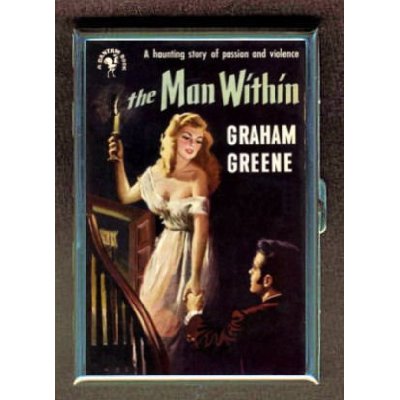
Graham Greene's The Man Within


The Man Within (1929) is Graham Greene’s first published novel. Greene was so embarrassed in later life by his first published work, a collection of poems called Babbling April, that he bought and destroyed copies wherever he could find them. He thought that his next two novels after The Man Within, The Name of the Action (1930) and Rumour at Nightfall (1931), were so bad that he steadfastly refused to allow them to be reprinted. However, Greene allowed The Man Within to be reissued in 1947 adding this Author’s Note:

“The Man Within was the first novel of mine to find a publisher. I had already written two novels, both of which I am thankful to Heinemann’s for rejecting. I began this novel in 1926 , when I was not quite twenty-two, and it was published with inexplicable success in 1929, so it has now reached the age of its author. The other day I tried to revise it for this edition, but when I had finished my sad and hopeless task , the story remained just as embarrassingly romantic, the style as derivative, and I had eliminated perhaps the only quality it possessed - its youth. So in reprinting it not a comma has been altered intentionally. Why reprint then? I can offer no real excuse, but perhaps an author may be allowed one sentimental gesture towards his own past, the period of ambition and hope.”

The Man Within is very polished and well written for the maiden effort of a young man in his early twenties. Although the book drags in the beginning, by the middle you can start to see the Greene who will be the author of Brighton Rock and The End of the Affair begin to emerge.

The Man Within is set in the late 19th century on the English coast. It is the story of Francis Andrews who is tormented by the memory of his dead father, a smuggler. Andrews hates his father for the abuse of his mother which eventually led to her death. (According to some critics, this may have been a Freudian way for Greene to explore his feelings about his own father, an English school master). While his father was alive, Andrews had been sent off to a boarding school where he learned Latin and Greek. The right hand man of Andrews’ father, Carlyon, has now become captain of the smuggling ship and convinces Andrews to come along. Whereas the other smugglers are ruffians, Carlyon is a man of culture and learning and Andrews looks up to him as a big brother figure.

Andrews eventually tires of being a smuggler and resents the constant comparison of him to his father. The crew looked up to Andrews’ father as a great man, although Andrews knows that with his wife and children he was an uncaring brute. Out of hatred for his dead father, Andrews informs the customs authorities as to where and when a shipment of smuggled goods will be landing. The smugglers get into a shoot out with law enforcement and a customs officer is killed. All but three of the smugglers are arrested and charged with murder.

Andrews flees to a rural cabin occupied by a young woman named Elizabeth. The man who Elizabeth lived with, who had taken care of her since the death of her mother, has just died. In the last years of his life, the man had made sexual advances to Elizabeth which she had rebuffed. Andrews is smitten with Elizabeth and it is a case of love at first sight.


Andrews views himself as a coward and wants to keep running from his pursuers. Elizabeth convinces Andrews to stop fleeing from the other smugglers and testify against them in Court. Andrews does this, but the townspeople are sympathetic to the smugglers and the jury acquits the Defendants. Andrews is warned that the smugglers intend to get revenge against Elizabeth for hiding Andrews out. Andrews then returns to Elizabeth’s cottage where he tries to convince her to run away with him. Elizabeth convinces Andrews to go for help. Andrews returns too late as Elizabeth has been killed by the angry smugglers. When the police arrive, Andrews is alone with Elizabeth’s body and takes the blame for killing her so that he can commit judicial suicide and join Elizabeth in death after his execution. The End.

Andrews is an insufferable emotionally tortured wimp and is not a very likeable character. He pledges undying love for Elizabeth but runs off and jumps in bed with an attractive harlot the first chance he gets and then feels guilty about it. The first half of the novel goes on interminably with Andrews swooning over Elizabeth’s good looks, moral purity and saintliness. In the second half, the book picks up speed and we start to see the Graham Greene that is to come. The portion of the novel dealing with the trial of the smugglers is tightly and skillfully written. It begins to drag again when Andrews returns to Elizabeth’s cottage, and the ending is simply stupid.


However, The Man Within does present, in embryo form, the preoccupations of Greene’s later work. Throughout the novel there is a brooding pre-occupation with death and the existence of God.

“She says there is a God, he thought, and no God could help but guard her. Yet what strange ideas of guardianship gods had, for those who were most their own they often paid with death, as though the failure of life itself was not a branch of guardianship. . . . I would rather trust to a devil to look after his own than a god, he thought, for there seemed to him nothing more final and irrevocable than death. It did not occur to him that Elizabeth’s death might be irrevocable only to him and his desire . . . If love survived the body, as church people believed, why not also jealousy, split like a bitter wine into the unhoused spirit?”

Although The Man Within is not a great novel, like every other Graham Greene novel which I have read so far, The Man Within is well worth reading.

Monday, September 6, 2010

Graham Greene's The End of the Affair


In my effort to read all of Greene's so-called "Catholic novels," I finally got around to The End of the Affair (1951).

This book is about adultery, sin, redemption and the nature of faith. Elements of the book may be loosely based on Greene's notorious real life carryings on with various of his mistresses, especially Lady Catherine Walston.

The End of the Affair doesn't involve a love triangle, it involves a love rectangle. The four lovers being Sarah Miles, her husband Henry, Maurice Bendrix, and God.

The book is primarily the story of the lovers Sarah Miles and Maurice Bendrix. Sarah is in a loveless marriage to a civil servant named Henry Miles. Then just before the outbreak of World War II, Sarah becomes involved in a passionate love affair with the novelist Maurice Bendrix.

The love affair reaches its climax during the London blitz. In 1944, while making love in Bendrix' apartment, a German V-1 rocket lands near by and Bendrix is hit by a falling door. Thinking that he has been killed, Sarah, who is an agnostic, sinks to her knees and promises God that if Bendrix lives she will give him up.


Ralph Fiennes and Julianne Moore as Maurice Bendrix and Sarah Miles

Sara ends the affair with Bendrix. After two years, in 1946, Bendrix happens to run into Sarah's husband Henry. Henry confides in Bendrix that he thinks that Sarah is having an affair. Jealous at the thought that Sarah had left him for another lover, Bendrix hires a private detective to follow her.

Sarah is indeed involved with another lover for whom she has left Bendrix: God. A big theme of The End of the Affair is the nature of faith. Sarah is desperately unhappy in her marriage and wishes to leave Henry to be with Bendrix. She rationalizes that if God doesn't really exist then she is free to do as she pleases. In order to try to convince herself of God's non-existence, she begins studying with a notorious atheist intellectual. Unfortunately, atheist arguments against the existence of God only convince Sarah that God is real and that she must keep her promise.

Sarah begins taking instruction from a Catholic priest, and performs random acts of kindness. At one point, she prays that she could take Christ's place on the cross and suffer for the redemption of humanity. Her wish is granted, as shortly thereafter, Sarah dies from pneumonia.

After Sarah's death there are several miraculous healings associated with her intercession in Heaven. (Apparently, the long-term enthusiastic commission of the sin of adultery doesn't cause Sarah to have to spend much time in Purgatory, since she seems to zip straight to the presence of the Beatific Vision!). In other words, it turns out that Sarah Miles was a Saint.

After finding out that his girlfriend left him for God, who then proceeded to take her away permanently, Bendrix, who has been an atheist, hates God. Bendrix realizes that he cannot hate God and remain an atheist since hate is just the other side of love. In order to hate God, Bendrix must first believe in Him.

The End of the Affair is rightly recognized as one of the greatest novels of the 20th century.

Friday, August 27, 2010

GRAHAM GREENE'S BRIGHTON ROCK


In trying to catch up on my reading, I just finished Graham Greene’s classic Brighton Rock first published in 1938. The Heart of the Matter left me unsettled, but I really don’t know what I think about this book.

The title refers to hard candy sold at the beach in the town of Brighton in England. Brighton Rock is the story of a teenage gangster named Pinkie Brown, his hapless girlfriend Rose, and a busybody named Ida Arnold. Sound like a bizarre plot? Well, Brighton Rock is a bizarre book.

The plot of Brighton Rock is readily available elsewhere on the internet so I won’t bother everyone with it here. What I want to focus on are the much heralded theological aspects of the novel. Brighton Rock is considered to be one of Greene’s “Catholic Novels,” the others of which are The Heart of the Matter, The End of the Affair, and The Power and the Glory. Although Greene habitually throws in some reference to the Church or Catholicism in his thrillers and “entertainments,” like the daughter who goes to Catholic school and says her rosary in Our Man in Havana.

Greene has said that when he started writing Brighton Rock he intended it to be a conventional thriller or detective story, hence the exciting opening chapter which describes a chase and a murder. The novel’s famous opening line sets the stage for what follows:

“Hale knew, before he had been in Brighton three hours, that they meant to murder him.”

Hale is indeed murdered. At Hale’s sparsely attended funeral, the Anglican priest mouths the platitudes of modern religion of the “I’m OK, You’re OK, God’s OK” type:

‘Our belief in heaven,’ the clergyman went on, ‘is not qualified by our disbelief in the old medieval hell. We believe,’ he said, glancing swiftly along the smooth polished slipway towards the New Art doors through which the coffin would be launched into the flames, ‘we believe that this our brother is already at one with the One.’ He stamped his words like little pats of butter with his personal mark. ‘He has attained unity. We do not know what that One is with whom (or with which) he is now at one. We do not retain the old medieval beliefs in glassy seas and golden crowns. Truth is beauty and there is more beauty for us, a truth-loving generation, in the certainty that our brother is at this moment re-absorbed in the universal spirit.’

It astounds me that Greene was already able to poke fun at New Age babble like this in the late 1930's. This kind of stuff sounds good but has no real content. This is not a religion that a person will give his life for.

Ida Arnold, who was a woman that Hale picked up in an attempt to avoid being killed, becomes obsessed with finding Hale’s killer and bringing him to justice. Ida represents the modern person. She has no religious beliefs to speak of, she just believes in “right and wrong.” However, Ida finds no fault in anything which brings her pleasure. Ida sees nothing wrong with casual sex, for instance. “It’s natural” she says, and there’s nothing wrong with it.

“She wasn’t religious. She didn’t believe in heaven or hell, only in ghosts, ouija boards, tables which rapped and little inept voices speaking plaintively of flowers.”

So while “the good guys” in this novel are not religious, “the bad guys” are very religious. Hale’s killer Pinkie was reared as a Roman Catholic, sings parts of the Mass to himself, and believes in all of the doctrines of the Church. Outside of the fact that Pinkie is also an evil psychopathic killer, he’s not a bad bloke.

Pinkie believes in Hell and knows that when he dies in a state of mortal sin that he will certainly go to it. In the back of his mind, Pinkie hopes that he’ll be able to make a confession and be granted absolution before his death. If Pinkie dies and goes to Hell in the meantime, well, as they said in The Godfather, it ain’t personal, it’s just business.

Pinkie kills Hale for being involved with the murder of the gang leader Kite. Then he kills a member of the gang named Spicer so that Spicer can’t talk. Pinkie seduces the hapless Rose, a 16 year old waitress in a greasy spoon who can give incriminating testimony against him, and convinces her to marry him.

Rose is also a Roman Catholic. Before their civil marriage ceremony, Rose goes off to confession but then realizes that marrying Pinkie in a civil ceremony outside the Church is a mortal sin so it doesn’t make any difference anyway. Rose and Pinkie are very moral in a bizarre kind of way. Rose knows that Pinkie is a murderer, but makes a conscious decision to go to Hell with him.

Although neither Pinkie or Rose believe that their civil marriage is valid in the eyes of God, they refrain from sex until they are married. In fact, Pinkie has a revulsion of the entire idea of sexual intimacy from listening to his parents make love through the thin walls of a poor tenement apartment. Pinkie says that listening to his parents in their bedroom disgusted him so much that he swore he would become a priest. However, when the time comes on the wedding night, Pinkie overcomes his disgust and does his duty.

Since Rose is convinced that she is going to Hell by living in sin with Pinkie anyway, she is ready to commit the ultimate mortal sin by taking her own life when Pinkie asks her to. Rose winds up throwing the gun she is supposed to kill herself with away and Pinkie accidentally splatters acid all over his face (in grim preview of where his soul is headed) before he plunges over a cliff and dies to avoid capture by the police.

If any of the above makes sense to you, then you may be either (1) a deranged lunatic, (2) a Graham Greene fan, (3) a Catholic, or (4) all of the above.

Greene seemed to be obsessed with mortal sin and damnation. This led George Orwell to famously opine that Greene apparently viewed Hell as an exclusive high class nightclub open only to Catholics.

I can’t really say that I enjoyed reading Brighton Rock, but it certainly provided much food for thought. Graham Greene was a one of a kind author. It may just be that Brighton Rock is a great work of literature.


Pinkie & Rose in a film version of Brighton Rock


Graham Greene

Saturday, June 5, 2010

The Heart of the Matter


I've been catching up on my reading of "Catholic novels" lately. This afternoon I finished Graham Greene's famous 1948 novel The Heart of the Matter. Honestly, I don't know what I think of it. Like everything I have ever read by Greene so far, the book is well written and engaging. The characters are well drawn and the reader comes to care about what happens to them.

However, The Heart of the Matter is a strange novel. I can't do any better than George Orwell's review for the July 17, 1948 edition of The New Yorker magazine. Orwell's review is literature in in its own right:

Here is the outline of the story: A certain Major Scobie, Deputy Commissioner of Police and a Catholic convert, finds a letter bearing a German address hidden in the cabin of the captain of a Portuguese ship. The letter turns out to be a private one and completely harmless, but it is, of course, Scobie's duty to hand it over to higher authority. However, the pity he feels for the Portuguese captain is too much for him, and he destroys the letter and says nothing about it. Scobie, it is explained to us, is a man of almost excessive conscientiousness. He does not drink, take bribes, keep Negro mistresses, or indulge in bureaucratic intrigue, and he is, in fact, disliked on all sides because of his uprightness, like Aristides the Just. His leniency toward the Portuguese captain is his first lapse. After it, his life becomes a sort of fable on the theme of 'Oh, what a tangled web we weave', and in every single instance it is the goodness of his heart that leads him astray. Actuated at the start by pity, he has a love affair with a girl who has been rescued from a torpedoed ship. He continues with the affair largely out of a sense of duty, since the girl will go to pieces morally if abandoned; he also lies about her to his wife, so as to spare her the pangs of jealousy. Since he intends to persist in adultery, he does not go to confession, and in order to lull his wife's suspicions he tells her that he has gone. This involves him in the truly fearful act of taking the Sacrament while in a state of mortal sin. By this time, there are other complications, all caused in the same manner, and Scobie finally decides that the only way out is through the unforgivable sin of suicide. Nobody else must be allowed to suffer through his death; it will be arranged as to look like an accident. As it happens, he bungles one detail, and the fact he has committed suicide becomes known. The book ends with a Catholic priest hinting, with doubtful orthodoxy, that Scobie is perhaps not damned. Scobie, however, had not entertained any such hope. White all through, with a stiff upper lip, he had gone to what he believed to be certain damnation out of pure gentlemanliness.

I have not parodied the plot of the book. Even when dressed up in realistic details, it is just as ridiculous as I have indicated. . . .


The Bad Catholic has to agree with Orwell. The book is well written, engaging, interesting, but . . . Orwell is right, the plot is ridiculous. Orwell is absolutely spot on, in my opinion, when he says that "If he (Scobie) were capable of getting into the kind of mess that is described, he would have got into it years earlier. If he really felt that adultery is mortal sin, he would stop committing it; if he persisted in it, his sense of sin would weaken. If he believed in Hell, he would not risk going there merely to spare the feelings of a couple of neurotic women."

At one point in the novel, when Scobie is taking communion in a state of mortal sin, and has decided to kill himself to spare the feelings of his wife and his mistress, he prays that God accept his damnation on their behalf. Greene is here almost parodying the Catholic theology of offering up one's suffering on behalf of others as a form of prayer. We can offer up suffering because Christ suffered. How can one offer up a sin as prayer? It is certainly interesting fiction but it's very, very bad theology.

Orwell's classic review of The Heart of the Matter has some other great quotes:

"In addition, it is impossible not to feel a sort of snobbishness in Mr. Greene's attitude, both here and in his other books written from an explicitly Catholic standpoint. He appears to share the idea, which has been floating around ever since Baudelaire, that there is something rather distingue in being damned; Hell is a sort of high-class night club, entry to which is reserved for Catholics only, since the others, the non-Catholics, are too ignorant to be held guilty, like the beasts that perish."


Or this quote, which I absolutely love:

"Every novelist has his own conventions, and, just as in an E.M. Forster novel there is a strong tendency for the characters to die suddenly without sufficient cause, so in a Graham Greene novel there is a tendency for people to go to bed together almost at sight and with no apparent pleasure to either party."

The Heart of the Matter is acknowledged to be one of the greatest novels of the 20th century. It's fun to think about the issues raised in the book and its fun to sit around and feel sorry for poor Scobie, but its terrible theology. And in fact, the ending of the novel shows that Scobie accomplished nothing by his suicide. His wife Louise knew he was having an affair all along and figures out that he committed suicide. Scobie's girlfriend, Helen, can't live with Scobie's death and sinks into moral depravity by being willing to sleep with any man who wants her. When asked what he thought happened to Scobie, Evelyn Waugh famously said "Scobie is in Hell." The Bad Catholic has to agree.


Graham Greene