“They threw me off the haytruck about noon.” So begins one of the most famous crime noir novels of all time,
The Postman Always Rings Twice.
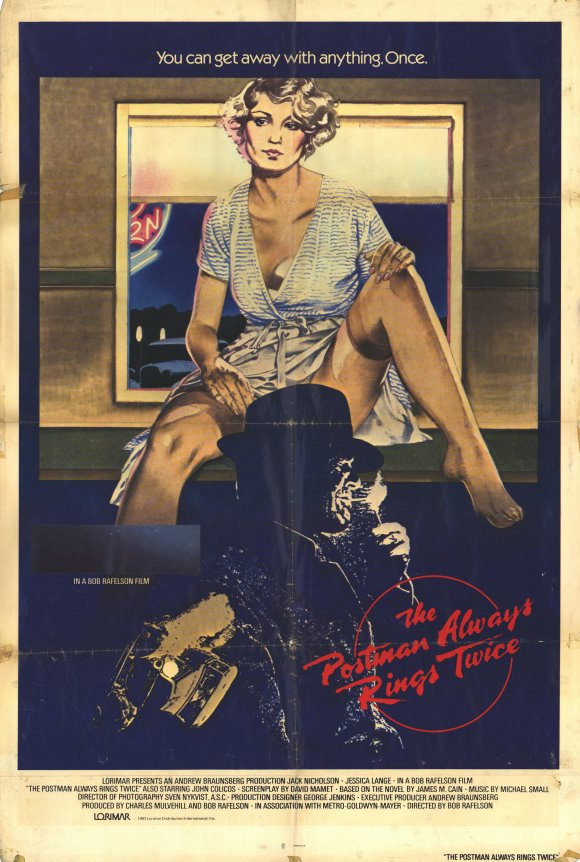
Neither of the two movies, neither the 1946 Lana Turner - John Garfield version nor the 1981 Jessica Lange - Jack Nicholson version, really do this book justice, although the Lange - Nicholson movie follows the novel much more closely. The “hard boiled” style has now been parodied so much that it is hard to realize how new and fresh this writing was in 1934 when
Postman was first published.
The plot of
Postman is well known. Frank Chambers is a no good drifter who lands at the Twin Oaks Tavern which, as Frank describes it,
“ . . . was nothing but a roadside sandwich joint, like a million others in California. There was a lunchroom part, and over that the house part, where they lived, and off to one side a filling station, and out back a half dozen shacks that they called an auto court.”
The Twin Oaks Tavern is owned by a middle aged Greek immigrant named Nick Papadakis and his pretty young wife Cora. Cora won a beauty contest in Iowa and came to Hollywood trying to break into the movie business. Although Cora’s looks may have been enough to make her a silent movie star, the recent advent of talking pictures has doomed any chance Cora has of being a movie star.
“They gave me a test. It was all right in the face. But they talk, now. The pictures, I mean. And when I began to talk, up there on the screen, they knew me for what I was, and so did I. A cheap Des Moines trollop that had as much chance in pictures as a monkey has. A monkey, anyway, can make you laugh. All I did was make you sick.”
After washing out in the movies, Cora is forced to wait tables in seedy dives. Cora has married “the Greek” for financial reasons. Although the Greek is a likeable man who works hard and treats Cora well, Cora does not love him and is not sexually excited by him. When the Greek offers Frank the drifter a job working in the gas station, Frank takes it with the idea of trying to seduce Cora. Being bored in her marriage, Cora is easily seduced. There is just a hint of Sado-Masochism in the first sexual encounter between Cora and Frank:
“I took her in my arms and mashed my mouth up against hers . . . “Bite me! Bite me!”
I bit her. I sunk my teeth into her lips so deep I could feel the blood spurt into my mouth. It was running down her neck when I carried her upstairs.”
This was very racy stuff in 1934. Lines like this and
“She looked like the great-grandmother of every whore in the world,” caused this book to be considered scandalous in its time and caused it to be one of those books which was “banned in Boston.”
In any event, Cora and Frank conspire to murder the Greek. Actually it’s more Cora than Frank. Even though Frank is a loser and an ex-con, he is a likeable character. After staying with Frank’s first person narration for the whole novel, the reader comes to feel that Frank is an old friend. Frank is reluctant to kill Nick when Cora first suggests it:
“. . . I’ve made one mistake. And I’ve got to be a hell cat, just once, to fix it. But I’m not really a hell cat, Frank.”
“They hang you for that.”
“Not if you do it right. You’re smart, Frank. I never fooled you for a minute. You’ll think of a way. Plenty of them have. Don’t worry. I’m not the first woman that had to turn hell cat to get out of a mess.”
“He never did anything to me. He’s all right.”
“The hell he’s all right. He stinks, I tell you. He’s greasy and he stinks. And do you think I’m going to let you wear a smock, with Service Auto Parks printed on the back, Thank-U Call Again, while he has four suits and a dozen silk shirts? Isn’t that business half mine? Don’t I cook? Don’t I cook good? Don’t you do your part?”
“You talk like it was all right.”
“Who’s going to know if it’s all right or not, but you and me?”
“You and me.”
Jack Nicholson and Jessica Lange as Frank Chambers and Cora Papadakis
Cora is really the ruthless one with the least moral scruples. Even though he becomes a cold blooded killer, Frank does seem to have a certain morality about him. Cora is eager to kill the Greek but Frank is a reluctant killer.
“He never did anything to me. He’s all right.” But Frank’s lust for sexy Cora outweighs Frank’s scruples.
Jessica Lange as Cora and John Colicos as "the Greek"
This novel is so well known, I feel no need to go through the entire plot in detail. Having been a lawyer in criminal courts for over twenty years, I felt that the courtroom and legal scenes in
The Postman Always Rings Twice are very realistic. I noticed that in the 1981 Jack Nicholson movie, the name of the conniving criminal defense lawyer, Katz, had been changed to something less Jewish sounding. I wonder if it was felt that Cain was making an anti-semitic swipe against “Jewish lawyers,” since Katz is interested only in making a big splash and winning his case and has no interest in justice whatsoever.
Since author James M. Cain was writing a morality tale, he couldn't allow the murderers to live happily ever after. Just when it looks like Frank and Cora are really going to settle down and have babies disaster strikes. After having gotten away with murdering the Greek, Frank is wrongfully convicted of murdering pregnant Cora after she dies in a tragic accident while Frank was trying to rush her to the hospital. The novel ends with Frank on death row about to be executed for the murder he didn’t commit.
According to
The Encyclopedia of Pulp Fiction Writers “Dashiell Hammett, Raymond Chandler, and James M. Cain are the father, son, and holy ghost of American hard-boiled literature.” Prior to authoring
Postman, Cain was a successful journalist and a not so successful playwright and screenwriter.
James M. Cain
Reportedly, the inspiration for
Postman was the Ruth Snyder - Judd Grey case where an adulterous couple conspired and murdered the woman’s husband. There is a famous picture covertly snapped by a reporter of Ruth Snyder dying in New York’s electric chair.
The infamous photograph of the execution of Ruth Snyder
The title has always caused some confusion since there is no postman in the story. Cain had originally named the story
“Bar-B-Que” but the publisher, Alfred A. Knopf, wanted another title. The “Postman” who “always rings twice,” is God or fate. Frank and Cora got away with murder the first time, but then the postman came back and delivered punishment.
Lana Turner and John Garfield as Cora Papadakis and Frank Chambers
Although Cain continued to write novels up until his death in 1977, he never recaptured the run away success of
The Postman Always Rings Twice. His next novel,
Double Indemnity (1943), is basically a re-hash of the same story, involving this time an insurance salesman and the wife of a client.
The Postman Always Rings Twice is short, only 35,000 words. Apparently, Knopf had to print it in larger than normal type to make it look like it was longer. As one article which I read on the internet said,
“It will take you longer to watch either movie version than to read the book.” Even after all these years,
The Postman Always Rings Twice is still able to work its magic on readers. It is still a powerful, gripping story and the sparse, muscular Hemingway-esque “hard-boiled” style can still grab you.
The Postman Always Rings Twice well deserves its reputation as a classic.